Introduction
Botox is often thought of as a quick fix for frown lines, but its benefits extend far beyond the cosmetic realm. This article explores the full spectrum of Botox’s therapeutic and aesthetic advantages, from reducing chronic migraine attacks and excess sweating to improving skin texture, acne, and facial harmony. By understanding how Botox temporarily blocks acetylcholine release, readers can see why it eas muscle overactivity in migraine, sweat glands, and even the sebaceous glands that produce oil. The goal is to provide a patient‑friendly overview that blends medical evidence with holistic wellness, highlighting how personalized Botox treatments can both alleviate medical conditions and enhance natural beauty. Whether you’re seeking relief from debilitating headaches, a drier under‑arm experience, or a subtle lift without surgery, this guide will illuminate the diverse, FDA‑approved uses of Botox and how they contribute to overall health optimization.
What Botox Is and How It Works
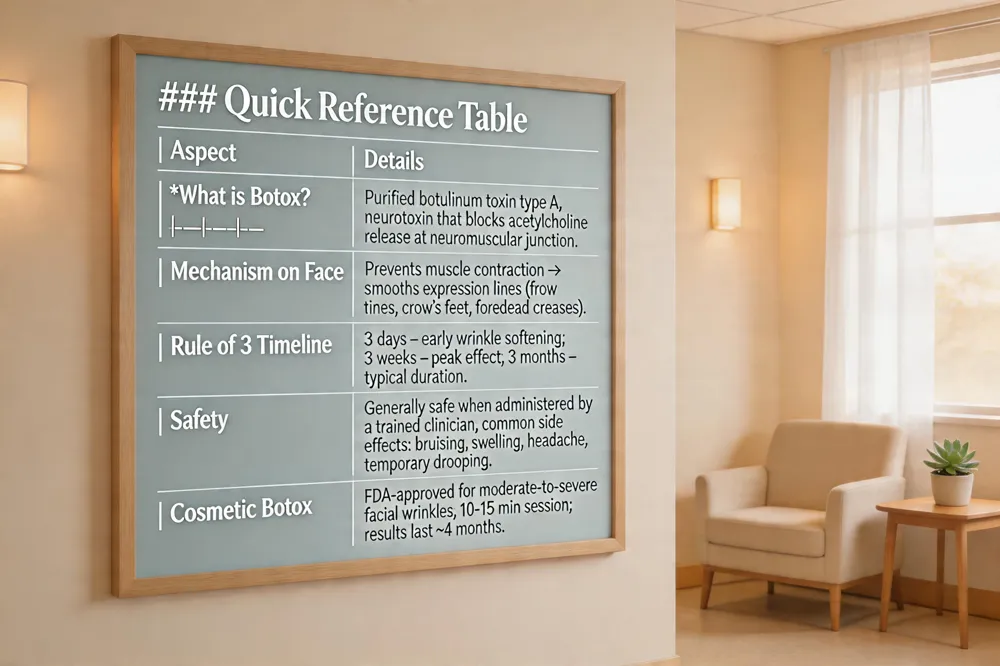
Quick Reference Table
| Aspect | Details |
|---|---|
| What is Botox? | Purified botulinum toxin type A; neurotoxin that blocks acetylcholine release at the neuromuscular junction. |
| Mechanism on Face | Prevents muscle contraction → smooths expression lines (frown lines, crow’s feet, forehead creases). |
| Rule of 3 Timeline | 3 days – early wrinkle softening; 3 weeks – peak effect; 3 months – typical duration. |
| Safety | Generally safe when administered by a trained clinician; common side effects: bruising, swelling, headache, temporary drooping. |
| Cosmetic Botox | FDA‑approved for moderate‑to‑severe facial wrinkles; 10‑15 min session; results last ~4 months. |
 What is Botox?
Botox is a purified, pharmaceutical‑grade form of botulinum toxin type A, a neurotoxin produced by Clostridium botulinum. When injected in small, controlled doses it blocks the release of acetylcholine at the neuromuscular junction, temporarily preventing targeted muscles from contracting. This temporary relaxation smooths facial wrinkles, reduces excessive under‑arm sweating, and can alleviate medical conditions such as cervical dystonia, chronic migraine, and overactive bladder.
How Botox works on the face
In facial muscles, Botox stops acetylcholine from binding to its receptors, halting muscle contraction. The relaxed muscles no longer pull on the overlying skin, so expression lines (frown lines, crow’s feet, forehead creases) soften. Effects begin within a few days, peak around three weeks, and last three to six months before nerve endings regenerate.
What is the “rule of 3” in Botox?
The rule of 3 is a quick timeline reminder: softening of wrinkles appears within three days, maximal effect occurs at about three weeks, and results typically persist for roughly three months.
Is Botox safe?
When administered by a licensed, trained clinician, Botox has a strong safety record. Common side effects are mild and localized (bruising, swelling, headache, temporary drooping). Rare serious complications arise only with improper technique or non‑approved products.
What is Botox Cosmetic?
Botox Cosmetic is the original FDA‑approved injectable for reducing moderate to severe facial wrinkles. A typical session lasts 10–15 minutes, with minimal downtime, and results last up to four months before a repeat treatment is recommended.
Therapeutic Uses: Migraine Prevention and Pain Management
Migraine Prevention Protocol
|
Details | |---|---| | Indication | Chronic migraine (≥15 headache days/month). | | FDA‑Approved Regimen | 31 injections (frontalis, temporalis, corrugator, occipital, semispinalis capitis, trapezius, cervical paraspinal) every 12 weeks. | | Efficacy | >50 % of patients achieve ≥50 % reduction in migraine days; onset 1‑2 weeks, peak 3‑4 weeks. | | Side Effects | Injection‑site pain, bruising, neck stiffness, flu‑like symptoms; rare swallowing difficulty or generalized weakness. | | Cost & Coverage | $600‑$1,200 out‑of‑pocket; many insurers cover with prior‑authorization; BOTOX® Savings Program may reduce cost to $0 for eligible. | | Pros/Cons | Pros: significant reduction, minimal downtime; Cons: repeat injections, possible mild side effects, ~30 % limited benefit. | | Patient Rating | Average 6.1/10; many report attacks dropping from dozens to a few per month. |
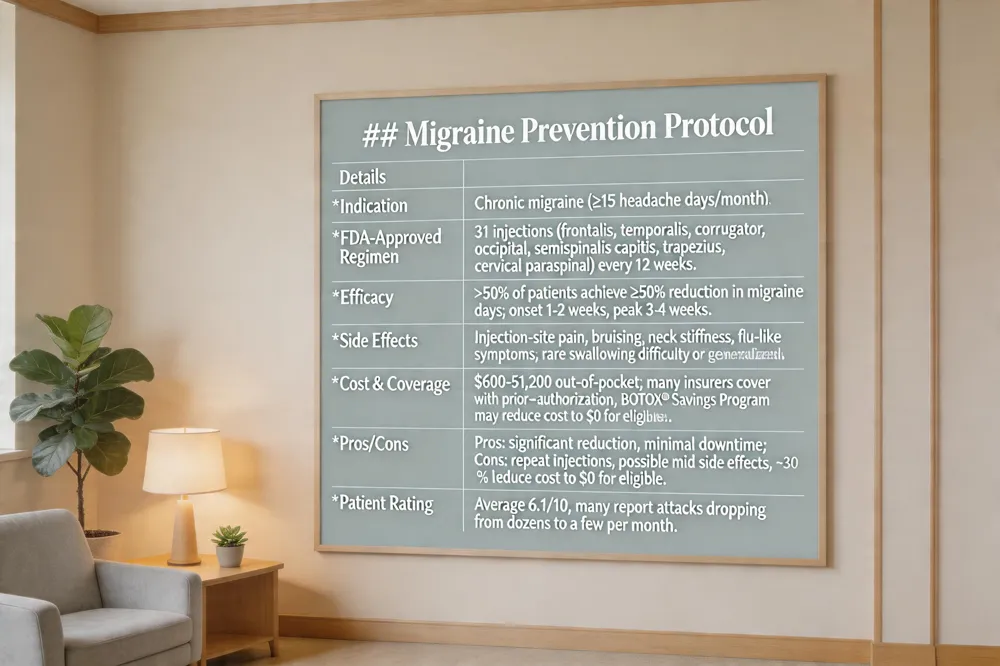 Chronic migraine treatment – Botox (onabotulinumtoxinA) is FDA‑approved for the preventive treatment of chronic migraine, defined as ≥15 headache days per month. Typical administration for migraine prevention involves 31 small injections into specific muscles of the head, neck, and shoulders every 12 weeks, targeting muscles that trigger pain.
Injection sites and protocol – Injections are placed in the forehead (frontalis), temples (temporalis and corrugator), the back of the head (occipital and semispinalis capitis), and the upper neck (trapezius and cervical paraspinal muscles). Some clinicians also treat the glabellar region and individualized “trigger points” based on each patient’s pain pattern.
Efficacy and long‑term effects – Clinical trials and real‑world studies show Botox is FDA‑approved for preventive treatment of chronic migraine headaches, with over 50% of patients experiencing at least a 50% reduction in migraine frequency, often noticeable within 1–2 weeks and peaking after 3–4 weeks. Repeated cycles maintain benefit, and long‑term use is generally well‑tolerated, with only mild muscle weakness or temporary eyelid droop reported.
Side‑effects profile – Common, temporary reactions include injection‑site pain, bruising, neck stiffness, and flu‑like symptoms. Rare but serious events such as swallowing difficulty or generalized weakness are uncommon and usually reversible.
Cost and insurance coverage – A full treatment costs roughly $600–$1,200 U.S. end‑of‑pocket, though many insurance plans cover Botox for chronic migraine when medical‑necessity criteria are met. The BOTOX® Savings Program can reduce out‑of‑pocket costs to $0 for eligible commercial patients.
Pros and cons – Pros: significant migraine‑day reduction, minimal downtime, and potential improvement in migraine‑related neck pain. Cons: requires repeated injections, possible mild side‑effects, and a subset of patients (≈30 %) may see limited benefit.
Patient perspectives – Reviews average a 6.1/10 rating; many report cutting attacks from dozens of days to a few per month, while others note dizziness or neck pain.
Insurance and local access – Coverage is common for chronic migraine, but prior‑authorization documentation (diagnosis, failed preventive meds, headache diary) is needed. For Brooklyn residents, Jana HealthCare offers specialized migraine‑relief programs with flexible financing.
Medical uses beyond migraine – Botox also treats hyperhidrosis, overactive bladder, cervical dystonia, spasticity, blepharospasm, and certain eye‑muscle disorders by temporarily relaxing overactive muscles.
Managing Excessive Sweating: Hyperhidrosis Solutions
Hyperhidrosis Treatment Summary
| Parameter | Details |
|---|---|
| Indication | Primary axillary hyperhidrosis (also palms/feet off‑label). |
| Protocol | 50 U per axilla (100 U/2.5 mL saline, 40 U/mL) injected in 5‑8 shallow points 1.5‑2 cm apart. |
| Onset & Duration | 3‑4 days for 70‑85 % sweat reduction; lasts 4‑6 months. |
| Cost | $1,000‑$1,500 per underarm course (≈100 U); $10‑$20 per unit. |
| Insurance | Covered when medically indicated with diagnosis & necessity letter; cosmetic use not covered. |
| Side Effects | Mild pain, bruising, flu‑like symptoms, brief muscle weakness; rare serious reactions. |
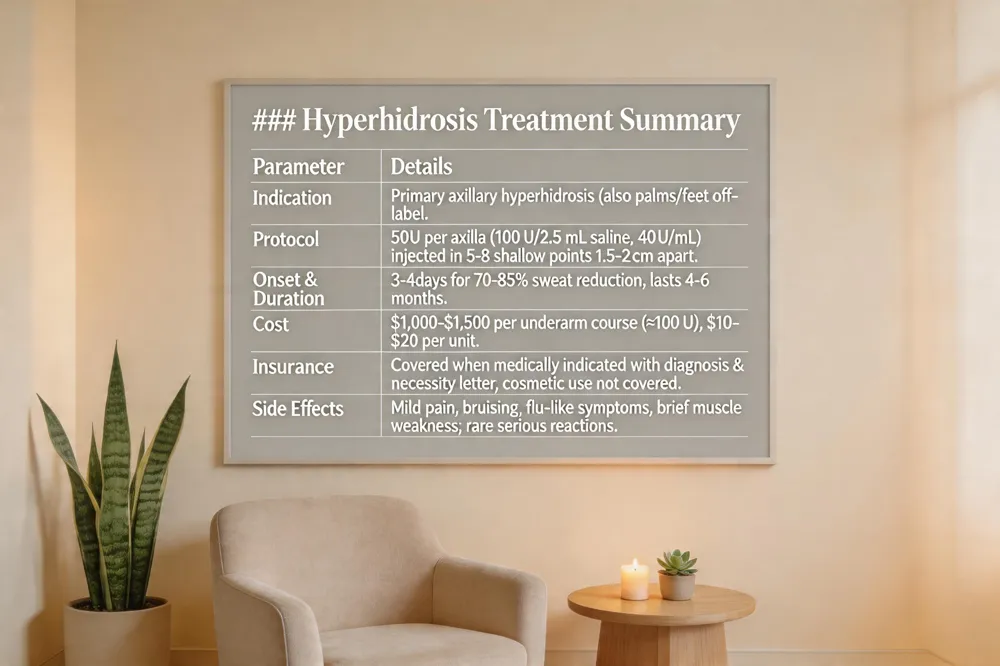 Hyperhidrosis—excessive sweating—can be life‑changing, but Botox (onabotulinumtoxinA) offers a fast, minimally invasive fix. After a simple iodine‑starch test maps the sweat‑gland‑rich zones, 50 U of BOTOX per axilla (reconstituted as 100 U/2.5 mL saline, 40 U/mL) is injected in 5‑8 shallow points 1.5‑2 cm apart. Within 3‑4 days patients see a 70‑85 % drop in sweat that lasts 4‑6 months; repeat treatments restore dryness when activity returns.
Insurance – Most U.S. plans cover therapeutic Botox for primary axillary hyperhidrosis when a physician supplies a diagnosis and a medical‑necessity letter. Cosmetic‑only uses are not covered. If denied, an appeal with additional clinical evidence often succeeds.
Finding a provider – Jana HealthCare (Brooklyn, NY) offers FDA‑approved hyperhidrosis injections, handling underarm, palm, and foot sites with a comfortable aesthetic setting.
Cost – Expect $1,000‑$1,500 for a full underarm course (≈100 U total), roughly $10‑$20 per unit. Out‑of‑pocket patients pay the full amount; insurers may reimburse when medically indicated.
Side effects – Mild pain, bruising, temporary flu‑like symptoms, or brief muscle weakness are common and resolve in days. Rare serious reactions (allergy, toxin spread) require immediate care.
Hands & feet – Off‑label Botox for palmar or plantar hyperhidrosis uses the same dilution, delivering 80‑90 % sweat reduction for 4‑6 months, with occasional temporary grip weakness that quickly improves.
Cosmetic Advantages: Skin Texture, Facial Contouring, and Beyond
Cosmetic Benefits Overview
| Benefit | How Botox Achieves It |
|---|---|
| Fine Lines & Texture | Relaxes tiny muscles → reduces repeated creasing, smaller pores, less oil. |
| Facial Contouring | Masseter reduction → softer jawline; depressor septi nasi/upper‑lip treatment → gentle lift, lip flip. |
| Brow & Neck | Units near brow arch raise brows; micro‑Botox on neck smooths “tech‑neck” bands. |
| Patient Preferences | Gen Z favor natural movement; autoimmune patients (e.g., Hashimoto’s) safe with stable thyroid. |
| Durability | Results last 3‑6 months; repeat sessions maintain improvement. |
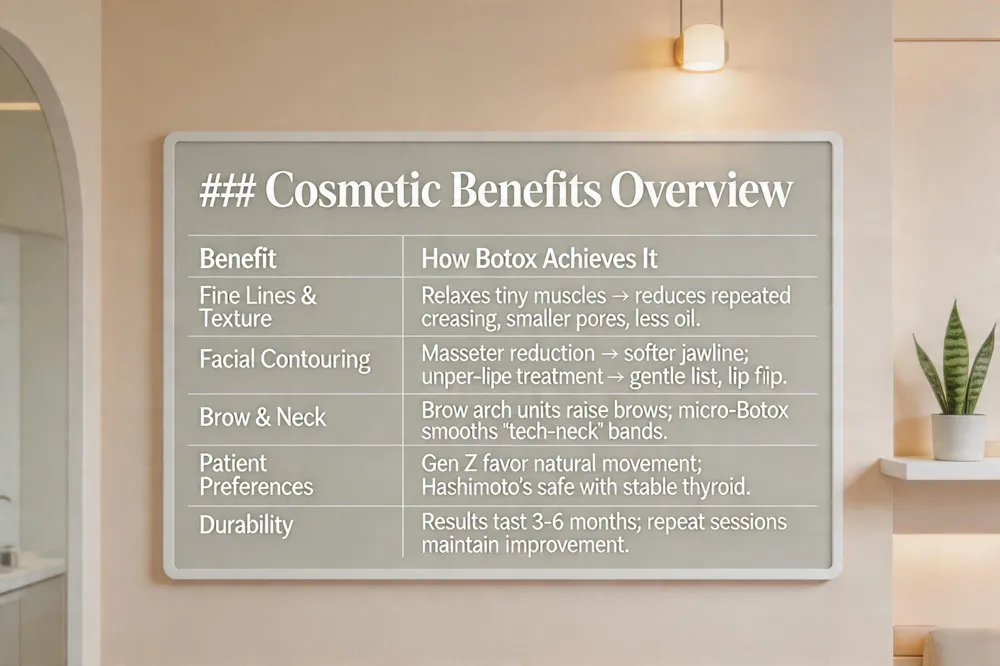 Botox does more than smooth frown lines; it subtly improves skin quality by relaxing tiny facial muscles that cause repeated creasing. This muscle‑relaxation reduces fine lines, refines texture, and often leads to smaller pores and less oil production, helping patients with acne‑prone skin notice a clearer, matte complexion. Targeted injections in the masseter muscles can soften a square jawline, while selective treatment of the depressor septi nasi or upper‑lip muscles creates a gentle lift that mimics a rhinoplasty or a “lip flip”, giving fuller‑looking lips and correcting a gummy smile. A few units placed near the brow arch raise the eyebrows without surgery, and micro‑Botox along the neck smooths horizontal “tech‑neck” bands for a more youthful silhouette.
Gen Z patients often prefer natural movement and may shy away from overt Botox, opting for preventive skincare and minimally invasive techniques that preserve expression. For those with autoimmune conditions such as Hashimoto’s disease, Botox remains safe when thyroid levels are stable and a qualified clinician tailors the dose and injection sites. Overall, Botox offers a versatile, low‑downtime option that enhances skin texture, facial symmetry, and confidence while fitting into a personalized, wellness‑focused aesthetic plan.
Practical Guidance: Treatment Planning, After‑Care, and FAQs
Practical Guidance Checklist
| Step | Recommendation |
|---|---|
| Pre‑appointment | Discuss goals, medical history, and injection sites (cosmetic, migraine, hyperhidrosis). |
| During Procedure | Provider uses sterile technique; typical session 10‑15 min. |
| 4‑Hour Rule | Stay upright, avoid lying down, bending, or vigorous exercise for 4 hours. |
| Post‑Care | Gentle cleansing, avoid excessive heat, keep area clean for 24 hours; expect mild bruising/swelling. |
| Results Timeline | 3‑7 days: initial improvement; 10‑14 days: peak; 3‑6 months: duration. |
| FAQ – Hair Botox | Not a toxin; a keratin‑protein treatment for hair texture only. |
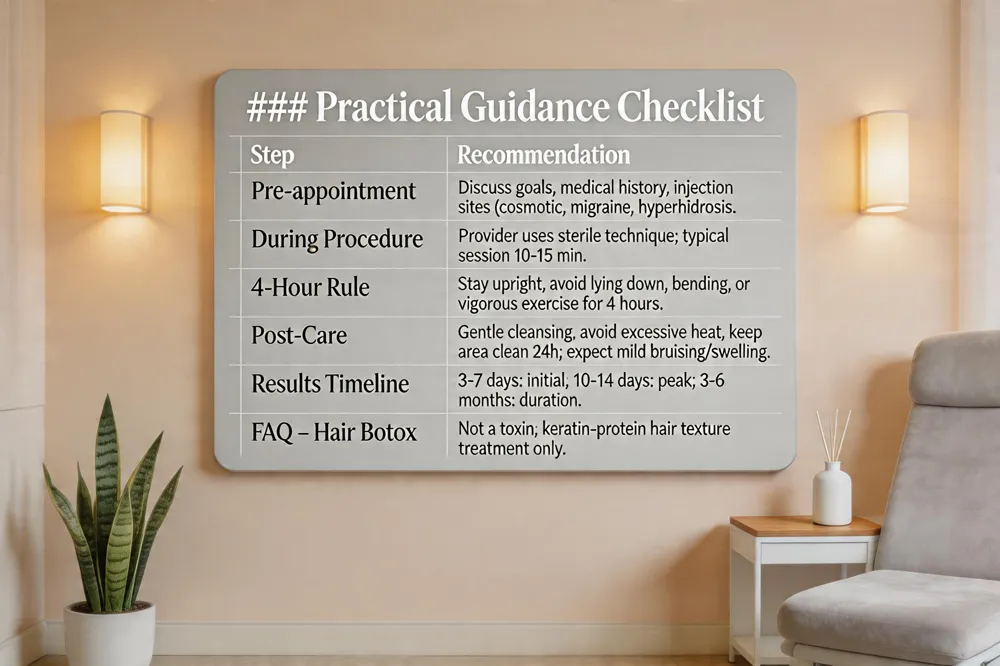 When you schedule a Botox session, the provider will discuss your goals, medical history, and the exact injection sites—whether for migraine prevention, hyperhidrosis, or cosmetic contouring. After the procedure, the most important rule is the 4‑hour rule: stay upright, avoid lying down or bending, and refrain from vigorous exercise for four hours to prevent toxin migration.
Hair Botox myth – unlike medical Botox, “Hair Botox” is a salon‑only protein treatment that coats each strand with keratin, collagen, and vitamins; it contains no botulinum toxin and works only on hair texture, not on muscles.
Post‑procedure care includes gentle cleansing, avoiding excessive heat, and keeping the treated area clean for the first 24 hours. Most patients experience mild bruising or swelling that resolves within a few days.
Patient experience and expectations – results typically appear within 3‑7 days, peak at 10‑14 days, and last 3‑6 months. Most people report improved confidence and comfort, especially when treating chronic migraine or hyperhidrosis, but they should understand that repeat treatments are needed to maintain benefits.
Conclusion
Botox’s versatility shines through its FDA‑approved medical uses—preventing chronic migraines, treating hyperhidrosis, overactive bladder, spasticity, and TMJ disorders—while its cosmetic prowess smooths wrinkles, lifts brows, refines jawlines, and even improves skin texture and acne. This dual‑action makes it a powerful tool for both health optimization and aesthetic confidence. If you’re curious about how a personalized Botox plan could address your unique concerns, schedule a consultation with the experienced team at Jana HealthCare. Embracing such targeted, minimally invasive treatments aligns with a holistic wellness approach that nurtures both body and mind.