Introduction
Health coaching is a client‑centered partnership that blends evidence‑based medicine with holistic wellness and aesthetic enhancement. At its core, a coach helps you explore personal motivations, discover strengths, and co‑create a roadmap for lasting change—whether that means improving nutrition, increasing activity, managing stress, or supporting skin health. Goal setting is the engine of this process. Using the universally endorsed SMART framework (Specific, Measurable, Achievable, Relevant, Time‑bound), vague wishes such as “feel healthier” become concrete actions like “walk briskly 30 minutes five days a week for the next six weeks.” Clear, measurable targets boost confidence, track progress, and keep you accountable. Jana HealthCare in Brooklyn, NY, integrates health coaching seamlessly with its multidisciplinary services—clinical care, cosmetic dermatology, and wellness therapies. After a medical assessment, a certified coach partners with physicians, dietitians, and aesthetic specialists to align lifestyle goals with treatment plans, ensuring that skin‑care regimens, nutrition counseling, and stress‑reduction techniques reinforce one another. This coordinated approach delivers personalized, data‑driven care that not only optimizes health outcomes but also enhances appearance and overall well‑being.
Foundations of Coaching
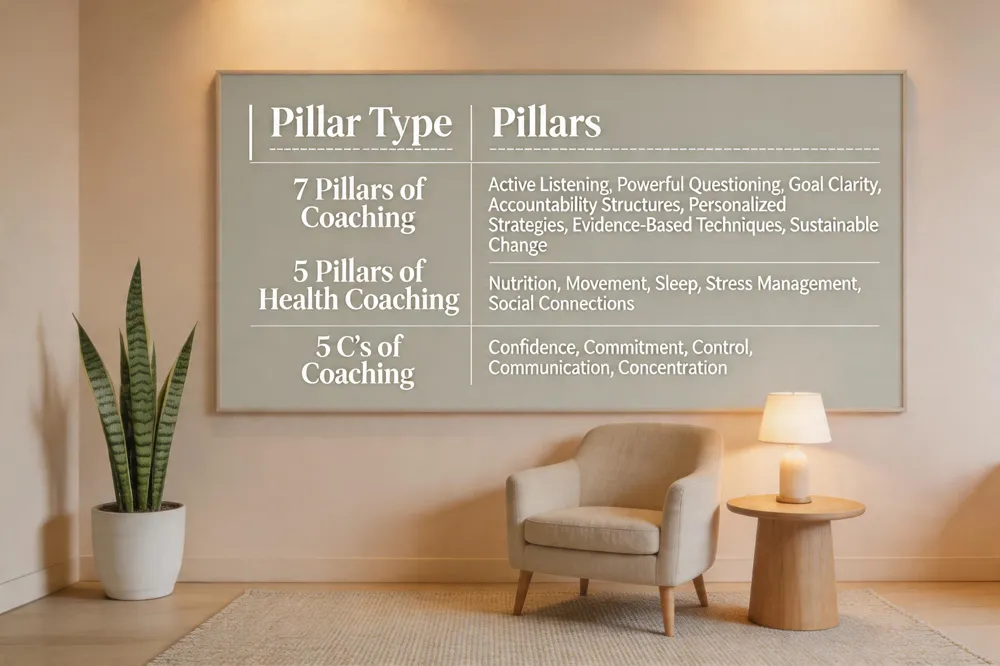
| Pillar Type | Pillars |
|---|---|
| 7 Pillars of Coaching | Active Listening, Powerful Questioning, Goal Clarity, Accountability Structures, Personalized Strategies, Evidence‑Based Techniques, Sustainable Change |
| 5 Pillars of Health Coaching | Nutrition, Movement, Sleep, Stress Management, Social Connections |
| 5 C’s of Coaching | Confidence, Commitment, Control, Communication, Concentration |
 What are the 7 pillars of coaching?
The seven pillars are active listening, powerful questioning, goal clarity, accountability structures, personalized strategies, evidence‑based techniques, and a focus on sustainable change. Together they create a reliable roadmap from the client’s current state to lasting transformation.
What are the 5 pillars of health coaching?
The five pillars cover nutrition, movement, sleep, stress management, and social connections. Each pillar supports overall well‑being—balanced eating fuels the body, regular activity builds strength, restorative sleep aids recovery, mindfulness reduces tension, and supportive relationships reinforce emotional health.
What are the 5 C’s of coaching?
The 5 C’s are Confidence, Commitment, Control, Communication, and Concentration. Confidence builds belief in ability, Commitment sustains goal pursuit, Control helps manage stress and decisions, Communication ensures clear dialogue, and Concentration maintains focus during each session.
Tools, Resources, and Templates
| Resource Category | Examples |
|---|---|
| Worksheets & Templates | SMART goal‑setting sheet, Habit‑tracking chart, Nutrition log, Stress‑management plan, Circle of Life® toolkit (screening forms, visualization scripts, values‑clarity exercises) |
| Free Tools | NASM exercise‑program templates, ICF coaching‑framework PDFs, Printable Canva worksheets (Positive Self‑Talk, SMART Goals, Wheel of Life) |
| Intake & Monitoring Forms | ICF intake forms, ACE Health Coach intake, Jana HealthCare HIPAA‑compliant Google Docs/PDF editors, Jotform medical‑intake & wellness questionnaires |
| Manuals & PDFs | ICF library PDFs, NASM resources, Catherine’s Health Center "Health Coaching Toolkit", VA "Whole Health Coaching Participant Manual", Jana HealthCare custom guide |
| Videos | Jana HealthCare YouTube (meal prep, mindfulness, success stories), ICF educational series, ACE Health Academy videos |
| Multimedia Learning | MyPlate.gov modules, American Heart Association webinars, Harvard Nutrition Source courses, habit‑tracker apps, peer‑support groups |
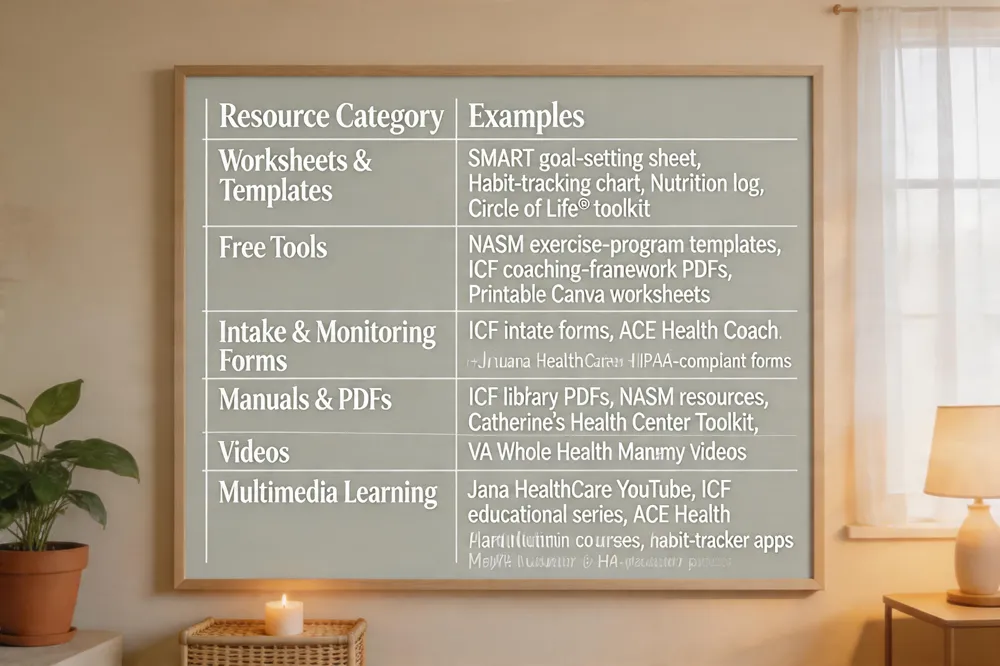 Health coaching resources and worksheets – Jana HealthCare offers downloadable worksheets that guide patients through SMART goal‑setting, habit tracking, nutrition logging, and stress‑management planning, all tailored to its integrated medical‑esthetic model. Free tools include NASM exercise‑program templates, ICF coaching‑framework PDFs, and printable Canva "Positive Self‑Talk," "SMART Goals," and "Wheel of Life" worksheets. The Circle of Life® coach toolkit adds screening forms, visualization scripts, and values‑clarity exercises to complement clinical services.
Free health coaching templates – Clients can download no‑cost templates from the ICF website, ACE Health Coach portal, and Jana HealthCare’s resource library. Collections feature intake forms, goal‑setting sheets, habit‑tracking charts, and progress‑monitoring grids that are HIPAA‑compliant and editable in Google Docs or PDF editors. Jotform also offers customizable medical‑intake and wellness‑questionnaire forms.
Health coaching manual PDF – Reputable PDFs are available from the ICF library, NASM website, and Catherine’s Health Center "Health Coaching Toolkit", which includes MI checklists and behavior‑change resources. The U.S. Department of Veterans Affairs’ "Whole Health Coaching Participant Manual" and Jana HealthCare’s custom guide synthesize best‑practice tools for clinicians and patients.
Health coaching videos – Jana HealthCare’s YouTube channel provides short videos on meal prep, mindfulness, and client success stories, while ICF and ACE offer additional educational series.
Becoming a Certified Coach
| Certification Pathway | Accrediting Body | Key Requirements | Typical Fees |
|---|---|---|---|
| NBC‑HWC (National Board Certified Health & Wellness Coach) | NBHWC | Complete NBHWC‑approved program, pass board exam, maintain CE credits | Program tuition varies; exam fee ≈ $200 |
| ICF Health Coach Credential | International Coach Federation | ICF‑accredited training, 60‑hour coach-specific education, mentor coaching, pass ICF exam | $300‑$500 (varies by provider) |
| NASM Certified Wellness Coach | NASM | NASM Certified Wellness Coach program, pass exam | $1,399 (full program) |
| ACE Health Coach Certification | ACE | ACE Health Coach program, pass ACE exam | $1,200 (incl. study materials) |
| Lifestyle Medicine Coach (LMC) | ACLM‑Wellcoaches | 21.5‑hour online course, pass assessment, eligible for NBC‑HWC/Wellcoach holders | $348 (member) / $435 (non‑member) |
| Academic Dual Credential | Georgetown University | Certificate in Health & Wellness Coaching (NBHWC & ICF accredited) + supervised practicum | $2,500‑$3,000 (per cohort) |
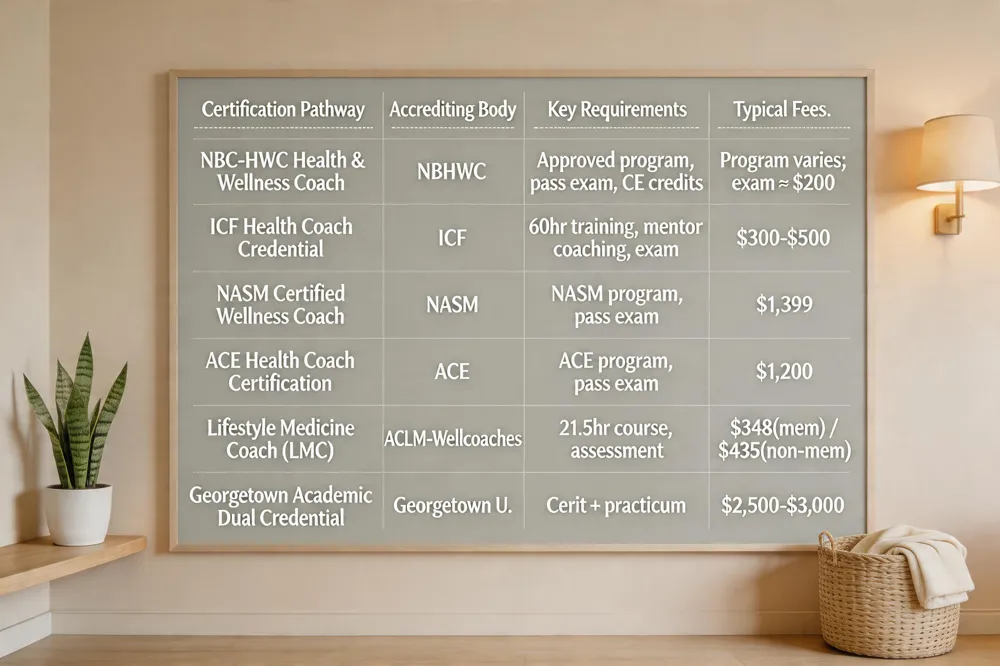 Embarking on a career as a health and wellness coach blends scientific rigor with holistic, patient‑centered care.How to become a health and wellness coach: Begin with a high‑school diploma or GED, then enroll in an accredited program recognized by the National Board for Health & Wellness Coaching (NBHWC) or NASM. Complete coursework, pass the NBHWC board exam to earn the NBC‑HWC credential, and gain hands‑on experience through internships or supervised client sessions. Build a portfolio, choose a specialty (e.g., nutrition, fitness, mental‑health), secure liability insurance, and market your services. Maintain credibility with continuing‑education credits and renewal.Health and wellness coach certification: Widely respected pathways include the ICF Health Coach credential, NASM Certified Wellness Coach, ACE Health Coach Certification, and the nationally recognized NBC‑HWC designation, which requires an approved training program and a board exam. Academic options such as Georgetown’s Certificate in Health & Wellness Coaching provide dual NBHWC/ICF accreditation and supervised practicum.Lifestyle medicine coach certification: The ACLM‑Wellcoaches 21.5‑hour online course leads to a Certificate of Attendance. Current NBC‑HWC or Certified Wellcoach® holders can earn the Lifestyle Medicine Coach (LMC) credential, covering nutrition, activity, sleep, stress, and behavior change. Fees are $348 for ACLM members, $435 for non‑members, with scholarships available. This credential highlights expertise in evidence‑based lifestyle medicine, enhancing professional visibility.
Career and Income Insights
| Metric | Details |
|---|---|
| Average Salary (U.S.) | $45,000‑$75,000 annually (full‑time $50,000‑$80,000) |
| NBHWC‑Certified Salary | $60,000‑$80,000 |
| Top 1 % Earners | Seven‑figure incomes |
| Regional Highlights | New York City: $70,000 avg; Dallas, Phoenix, San Francisco: above national median |
| Key Employers | Trinity Health, Highmark, Twin Health (digital‑health), Aetna, Jana HealthCare (Brooklyn) |
| Job Growth (BLS) | Health‑education roles +7 % (2024‑2033); Community health workers +13 % (2024‑2033) |
| Typical Settings | Corporate wellness, community health education, private practice, multidisciplinary clinics |
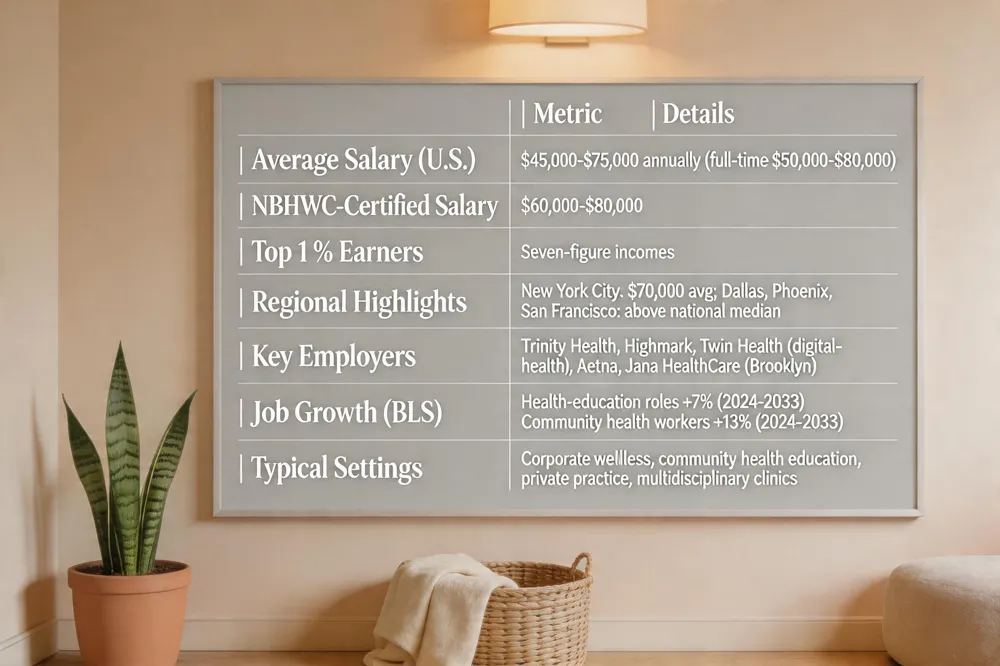 Health and wellness coaching is a fast‑growing field that blends lifestyle medicine, stress‑reduction, nutrition counseling, and even aesthetic wellness. In the United States, coaches typically earn $45,000‑$75,000 annually; full‑time averages range $50,000‑$80,000, with National Board certified professionals pulling $60,000‑$80,000 and top 1 % reaching seven‑figure incomes. Salaries climb in high‑cost markets—New York City averages $70,000, while Dallas, Phoenix, and San Francisco also pay above the national median. Job opportunities span corporate wellness, community health education, and private practice. Current security includes Trinity Health, Highmark, digital‑health firms like Twin Health, insurers such as Aetna, and multidisciplinary clinics such as Jana HealthCare in Brooklyn, where coaching dovetails with cosmetic dermatology and wellness therapies. The BLS projects a 7 % rise for health‑education roles and a 13 % surge for community health workers through 2033, reflecting strong market demand.
Coaching Practice Essentials
| Component | Description |
|---|---|
| Session Template | Check‑in → Review prior SMART goals/data → Client shares challenges → Set new SMART goal → Outline steps & resources → Summary & next‑step agreement → Schedule follow‑up |
| 80/20 (Pareto) Rule | Identify ~20 % of actions that deliver ~80 % of results (e.g., targeted wellness routine, skin‑care protocol) and prioritize them |
| 70/30 Rule | Client speaks ~70 % of the time; coach listens and guides ~30 % using open‑ended questions and reflections |
| Accountability Tools | Wellness journal, digital trackers, regular check‑ins, progress‑monitoring grids |
| Outcome Focus | Sustainable change, measurable progress, rapid plan adjustments |
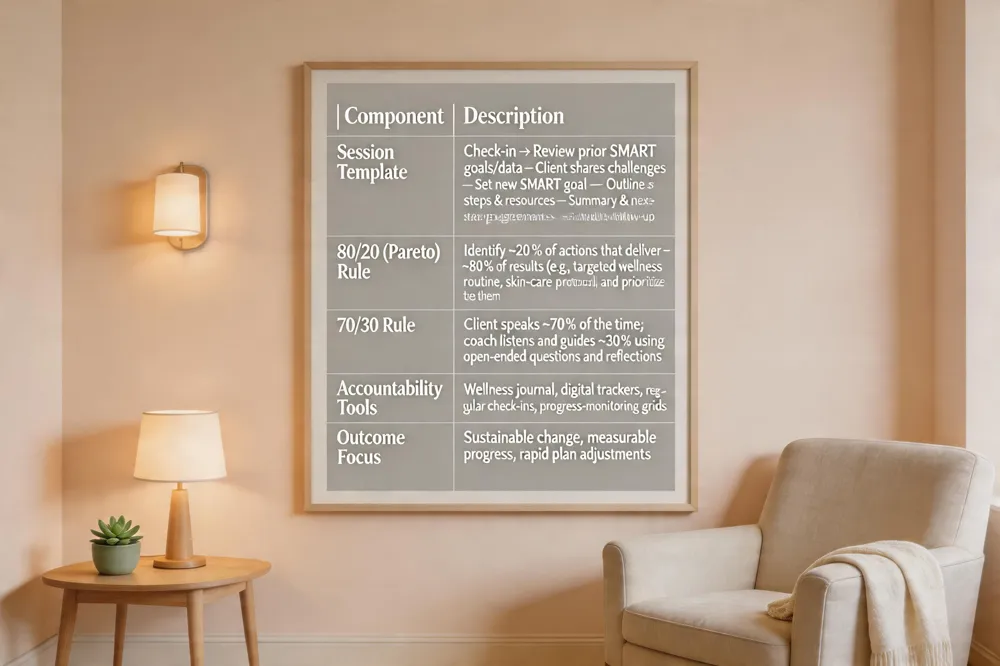 A health coaching session follows a focused template: a brief check‑in reviews prior SMART goals, data; the client shares challenges; together they set a new SMART goal, outline measurable steps, assign resources, and close with a summary, next‑step agreement, and scheduled follow‑up, all recorded for accountability.
In coaching, the 80/20 (Pareto) rule means ~20 % of effort yields ~80 % of results. Coaches pinpoint those high‑impact actions—like a targeted wellness routine, a skin‑care protocol, or a specific cosmetic treatment—and prioritize them to maximize outcomes with less overwhelm.
The 70/30 rule advises the client speaks ~70 % of the time, while the coach listens and guides for the remaining ~30 % using open‑ended questions and reflections.
Regular check‑ins, a wellness journal, and digital trackers keep the client accountable, celebrate progress, and allow rapid plan adjustments to sustain long‑term health and aesthetic goals.
Health Coaching Services at Jana HealthCare
| Service Area | Core Strategies |
|---|---|
| Mental‑Health Wellness Coaching | Meditation, breathwork, guided visualization; CBT techniques (reframing, gratitude journaling, sleep hygiene); gut‑brain nutrition; regular physical activity |
| Holistic Wellness Coaching | Whole‑person approach (physical, emotional, mental, spiritual); habit‑stacking; yoga; Ayurvedic principles; alignment with core values; integration with aesthetic treatments |
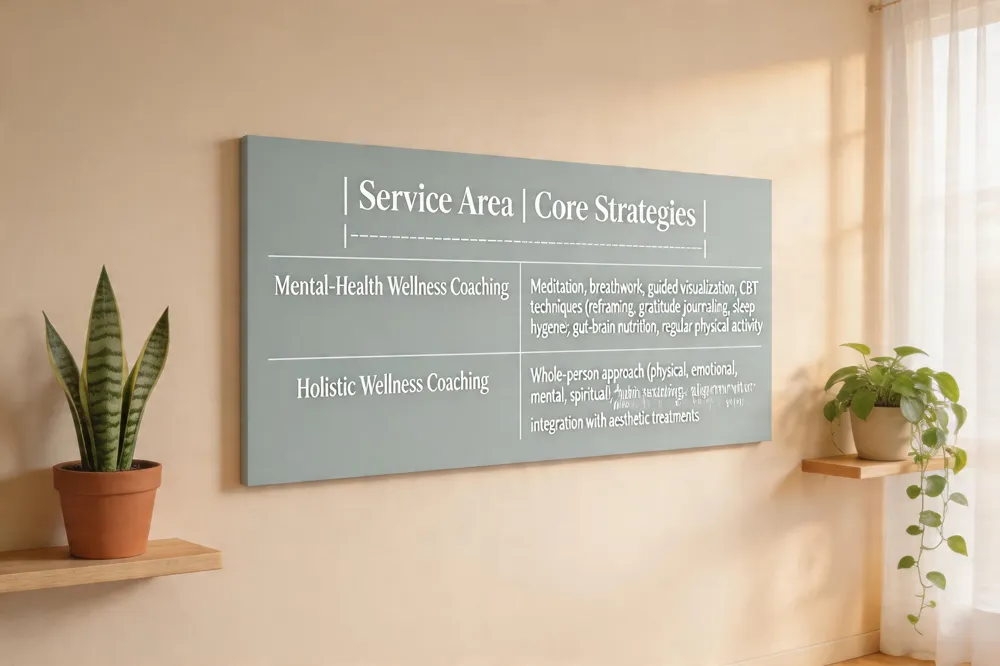 Wellness coaching strategies for mental health – Coaches integrate mind‑body tools such as meditation, breathwork, and guided visualization to calm the nervous system and lower anxiety. Cognitive‑behavioral tactics—reframing limiting beliefs, gratitude journaling, and sleep‑hygiene coaching—build emotional resilience. Nutrition focused on gut‑brain health and regular physical activity further support mood stability and stress management.
Holistic wellness coaching – A whole‑person approach addresses physical, emotional, mental, and spiritual health. Clients adopt sustainable habits through habit‑stacking, yoga, and Ayurvedic principles, aligning daily actions with core values. This comprehensive plan complements aesthetic treatments, ensuring that inner health and outward confidence reinforce one another for lasting well‑being.
Roles and Responsibilities of a Coach
| Responsibility | Details |
|---|---|
| Daily Duties | Initial assessments; SMART framework & Motivational Interviewing for goal setting; education on nutrition (MyPlate), physical activity (CDC 150 min/week), stress‑management, sleep hygiene; schedule regular check‑ins; document metrics (steps, BP, mood) |
| Client Partnership | Deep listening, empathy, collaborative mindset; uncover personal “why”; overcome barriers; celebrate milestones |
| Impact on Outcomes | Documented reductions in blood pressure, LDL‑C, weight (e.g., Live Heart Smart program); enhanced self‑motivation, accountability, habit formation; improvement in clinical health markers and overall well‑being |
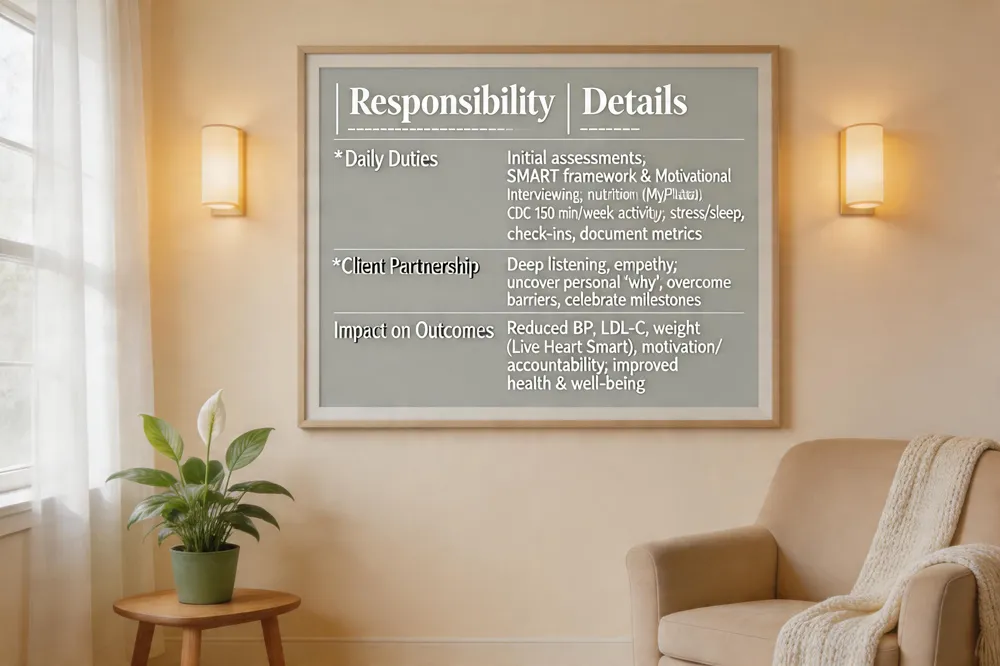 A health and wellness coach serves as a personal guide who partners with each client to translate broad wellness aspirations into concrete, actionable plans. Daily duties include conducting initial assessments, using evidence‑based tools such as the SMART framework and Motivational Interviewing to set Specific, Measurable, Achievable, Relevant, Time‑bound goals, and providing education on nutrition (MyPlate), physical activity (CDC’s 150 minutes/week guideline, stress‑management, and sleep hygiene. Coaches schedule regular check‑ins—by phone, video, or in person—to monitor progress, document metrics (e.g., steps, blood pressure, mood), and adjust the plan as needed. Client partnership is built on deep listening, empathy, and a collaborative mindset; the coach acts as a supportive ally, helping clients uncover personal “why,” overcome barriers, and celebrate milestones. Impact on outcomes is documented in U.S. programs such as Live Heart Smart, where coaching contributed to significant reductions in blood pressure, LDL‑C, and weight. By fostering self‑motivation, accountability, and habit formation, the coach enhances both clinical health markers and overall well‑being.
Multimedia Learning and Ongoing Support
| Resource Type | Examples |
|---|---|
| Video Resources | Jana HealthCare YouTube (meal prep, mindfulness, success stories); ICF motivational interviewing series; ACE habit‑stacking demos |
| Continuing Education | MyPlate.gov modules, American Heart Association webinars, Harvard Nutrition Source courses; live webinars; downloadable worksheets |
| Client Empowerment | Habit‑tracker apps, peer‑support groups, self‑efficacy building through regular multimedia access; dynamic, personalized wellness plans |
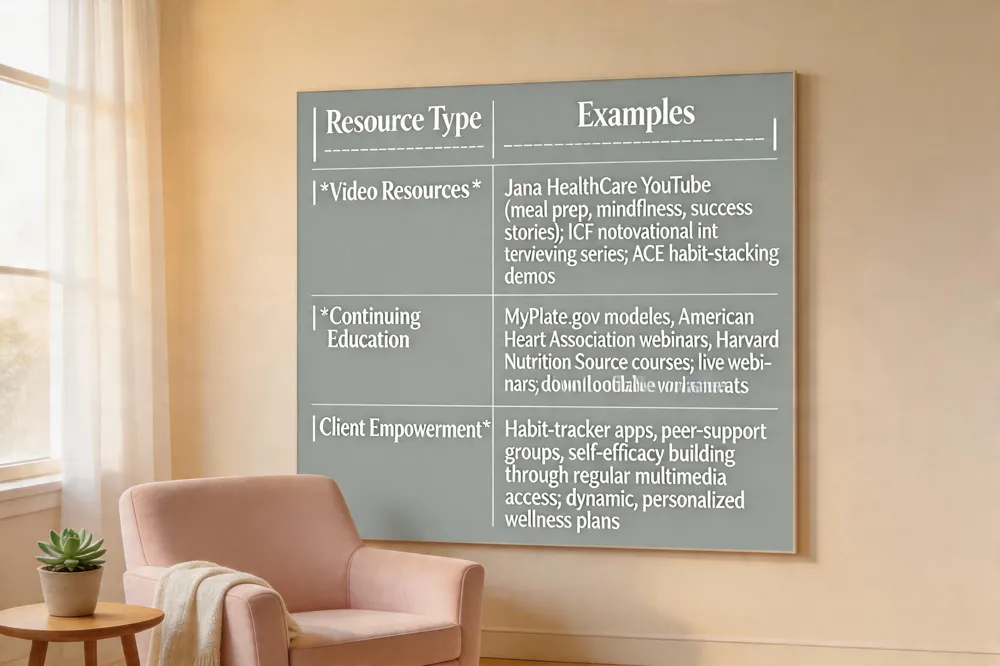 Effective health coaching extends beyond the one‑on‑one session by leveraging a variety of multimedia tools that keep clients engaged and empowered.
Video resources – Jana HealthCare's YouTube channel offers short, actionable videos on meal preparation, mindfulness exercises, and real‑world client success stories. Complementary series from the International Coach Federation (ICF) and ACE Health Academy provide evidence‑based demonstrations of motivational interviewing, SMART goal‑setting, and habit‑stacking techniques.
Continuing education – Both coaches and clients benefit from ongoing learning modules hosted on platforms such as MyPlate.gov, the American Heart Association, and Harvard Nutrition Source. Live webinars, digital worksheets, and downloadable templates reinforce core concepts like the CDC‑recommended 150 minutes of moderate activity per week and USDA MyPlate nutrition guidance.
Client empowerment – By regularly accessing these resources, clients build self‑efficacy, track progress with habit‑tracker apps, and stay accountable through peer‑support groups. This multimedia approach aligns with the Institute of Coaching’s emphasis on self‑discovery and sustainable behavior change, ensuring that wellness plans remain dynamic, personalized, and resilient over time.
Health coaching videos – Jana HealthCare's YouTube channel offers short videos on meal prep, mindfulness exercises, and client success stories; additional educational series are available from the ICF and ACE.
Conclusion
In this article we highlighted how a client‑centered, evidence‑based health‑coaching model can turn broad wellness wishes into measurable progress. Key take‑aways include: (1) following national guidelines—150 minutes of moderate aerobic activity per week, a balanced MyPlate diet, and adequate sleep; (2) using the SMART framework (Specific, Measurable, Achievable, Relevant, Time‑bound) to set clear, personalized goals; (3) leveraging Motivational Interviewing, mindfulness, and habit‑stacking to boost intrinsic motivation and resilience; and (4) integrating physical, mental, emotional, and aesthetic dimensions of health through a multidisciplinary team. These strategies have been shown to improve blood pressure, blood pressure, sleep gluc sleep and well, improve15 illness requires andif journey experience well‑being.
Take the next step today: write down one SMART goal, track your progress with a journal or app, and schedule a free 15‑minute discovery call with a certified health coach. Jana HealthCare in Brooklyn offers a seamless blend of medical care, cosmetic dermatology, and personalized wellness coaching—all designed to support your unique health and aesthetic goals. Contact us at (212) 555‑1234 or visit www.janahealthcare.com to begin your personalized wellness plan and experience the transformative power of integrated, patient‑focused care.