Why IV Therapy Is Trending
IV therapy has become a buzzword in wellness circles, largely thanks to high‑profile celebrities such as Madonna, Gwyneth Paltrow and Rihanna who showcase their “IV drips” on social media. Their endorsements have helped launch a booming medical‑spa market that was worth roughly $15 billion in 2022 and now includes nearly 9,000 facilities across the United States. The core idea behind the treatment is simple: a sterile needle places a small catheter into a peripheral vein, allowing vitamins, minerals and fluids to flow directly into the bloodstream. Bypassing the digestive tract gives the nutrients almost 100 % bioavailability and can achieve plasma concentrations that oral supplements cannot reach. While the scientific evidence for broad health benefits in well‑nourished adults remains limited, the promise of rapid energy, immune support and aesthetic rejuvenation continues to drive consumer demand. Many clinics tailor each cocktail to individual labs, lifestyle goals, and aesthetic preferences, positioning IV therapy as a personalized shortcut to health optimization.
Understanding IV Therapy Basics and Local Risks
Key Local Risks & Management
| Complication | Typical Signs | Immediate Management |
|---|---|---|
| Infiltration | Swelling, coolness, fluid leak, change in flow | Stop infusion, remove catheter, apply appropriate compresses, monitor tissue |
| Phlebitis (mechanical) | Redness, warmth, tenderness, palpable cord‑like vein | Elevate limb, apply heat, analgesia, consider catheter removal if severe |
| Phlebitis (chemical) | Same as mechanical, may have burning sensation | Slow infusion rate, dilute solution, monitor site |
| Phlebitis (infectious) | Increasing pain, swelling, purulent drainage, fever | Remove catheter, obtain cultures, start antibiotics |
| Post‑removal bruising/bleeding | Mild irritation, bruising at site | Apply pressure, monitor for expansion, educate patient |
| Vitamin IV side effects | Flushing, metallic taste, nausea, headache, light‑headedness | Slow rate, ensure proper hydration, observe for allergic signs |
 IV therapy delivers nutrients or fluids directly into a vein, offering rapid bioavailability but also exposing patients to local complications. The most frequent adverse event with peripheral IVs is infiltration, where fluid leaks into surrounding tissue, causing swelling, coolness, and a change in flow. Promptly stopping the infusion and removing the catheter prevents further injury.
Phlebitis—inflammation of the vein’s inner lining—is another common issue. It may be mechanical (catheter irritation), chemical (acidic or hypertonic solutions), or infectious (breaks in aseptic technique). Signs include localized redness, warmth, tenderness, swelling, or a palpable cord‑like vein. Prevention relies on using the smallest appropriate catheter gauge, rotating sites, securing the line, and verifying solution pH and osmolarity. Treatment varies: mechanical phlebitis often improves with heat, limb elevation, and analgesia; chemical phlebitis may require slower infusion or dilution; infectious phlebitis demands catheter removal, cultures, and antibiotics.
After catheter removal, patients may notice bruising, bleeding, or mild irritation at the site. Post‑removal phlebitis can persist up to 24 hours, presenting as redness, warmth, or tenderness. Infection may develop as increasing pain, swelling, purulent drainage, or fever, especially if aseptic technique was compromised.
Vitamin IV therapy side effects are generally mild, including bruising, swelling, flushing, metallic taste, nausea, headache, or light‑headedness. Rare but serious risks involve infection, fluid overload, electrolyte imbalance, or allergic reactions ranging from hives to anaphylaxis. Proper screening, slow infusion rates, and vigilant monitoring mitigate these risks.
Disadvantages of IV therapy include high out (often $250‑$800 per session, rarely covered by insurance), limited scientific evidence for claimed wellness benefits, and inherent procedural risks such as infection, phlebitis, infiltration, and potential nutrient toxicity when dosages are excessive. Patients should discuss risks, benefits, and alternatives with qualified healthcare professionals before pursuing IV vitamin treatments.
Assessing Safety and Eligibility
Eligibility Checklist & Contra‑Indications
| Patient Factor | Safe? | Notes |
|---|---|---|
| Severe kidney disease | ❌ | Risk of fluid overload & electrolyte imbalance |
| Uncontrolled hypertension | ❌ | May exacerbate cardiovascular stress |
| Active infection | ❌ | Increases risk of catheter‑related bloodstream infection |
| Known allergy to infusion components | ❌ | Must avoid specific vitamins/trace minerals |
| Pregnant or nursing | ⚠️ | Discuss risks; many providers defer elective therapy |
| Healthy adult seeking wellness | ✅ (with caution) | Evaluate cost‑benefit, monitor for complications |
| Malabsorption syndrome | ✅ | Therapeutic indication; monitor labs |
| Chronic fatigue syndrome (documented deficiency) | ✅ | May benefit; ensure proper dosing |
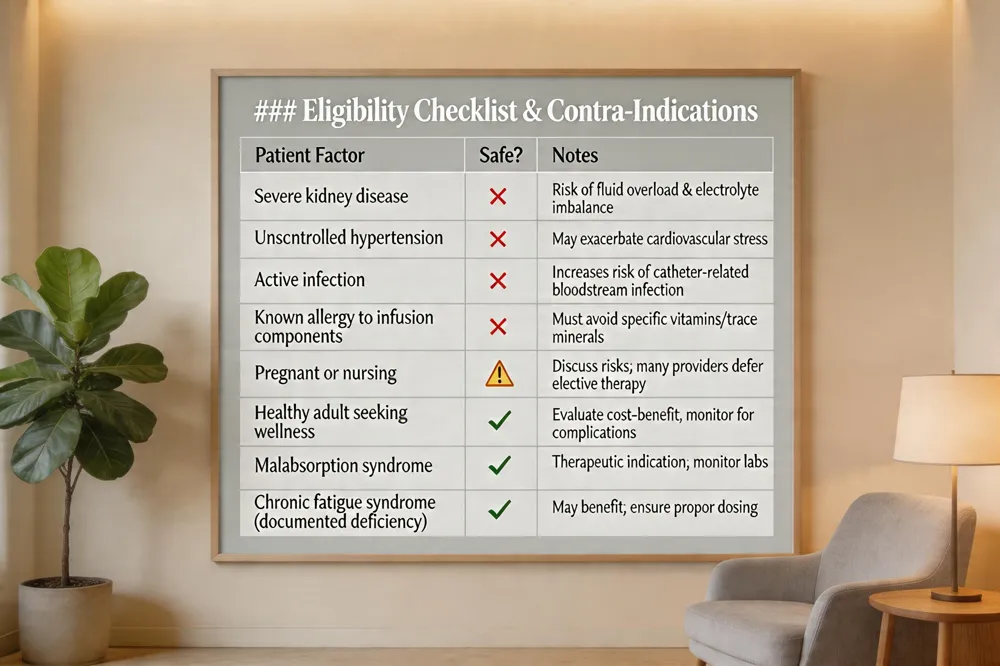 IV vitamin therapy can be safe when it is performed by qualified clinicians who follow strict sterile technique and use appropriate dosing. For patients with genuine medical needs—such as malabsorption syndromes, severe deficiencies, or certain chronic illnesses—the risk is low and the infusion may be beneficial. In healthy individuals, however, the procedure carries potential hazards, including infection, vein irritation, allergic reactions, and vitamin toxicity from high‑dose blends that are not FDA‑approved for general wellness.
The most common and serious risk is phlebitis, inflammation of the vein that may be mechanical, chemical, or infectious. It presents with pain, redness, warmth, and swelling along the catheter track and can progress to infection or thrombosis if not addressed promptly. Catheter‑related bloodstream infections, infiltration, and extravasation are additional concerns that require vigilant monitoring.
Patients who should avoid IV therapy include those with severe kidney or heart disease, uncontrolled hypertension, active infections, liver failure, or known allergies to any infusion component. Pregnant or nursing individuals and people on strict fluid‑restriction diets should also discuss risks with their provider before proceeding.
Systemic complications can range from fluid overload and electrolyte imbalance to rare events such as air embolism, severe allergic reactions, or sepsis. Early detection, proper site care, and immediate cessation of the infusion are essential to prevent these outcomes.
Cost, Insurance, and Practical Considerations
Financial Overview
| Item | Typical Cost (USD) | Insurance Coverage |
|---|---|---|
| Standard IV vitamin drip | $150‑$250 | Usually not covered (elective) |
| Premium blend (e.g., glutathione, high‑dose vitamin C) | $250‑$300 | Rarely covered unless medically indicated |
| Package of 5 sessions | $700‑$1,200 (discounted) | May be reimbursed partially with prior authorization for a diagnosed deficiency |
| Physician‑prescribed therapeutic infusion (e.g., severe dehydration) | $200‑$400 | Possible full or partial reimbursement after coding & authorization |
Frequency Recommendations
- General wellness: monthly
- Athletes/high‑stress professionals: bi‑weekly or weekly
- Post‑illness recovery: start weekly, taper based on labs
 IV vitamin drips typically cost $150‑$300 per session in a well‑run med spa such as Jana HealthCare in Brooklyn, NY, where a standard infusion runs about $150‑$250 and premium blends (glutathione, high‑dose vitamin CC zinc) can approach $300. Most private insurance plans treat wellness IVs as elective and do not cover them; however, when a physician prescribes an infusion for a medically necessary indication—severe dehydration, documented nutrient deficiency, chronic fatigue, or post‑bariatric recovery—major carriers may reimburse all or part of the cost after proper coding and prior authorization.
Frequency depends on the goal: healthy adults often schedule a monthly “maintenance” drip, athletes or high‑stress professionals may opt for bi‑weekly or weekly sessions, while patients recovering from illness might start weekly and taper as labs improve. The exact schedule should be personalized based on labs, lifestyle, and clinician guidance.
To find a local provider, search “IV vitamin therapy near me.” Jana HealthCare offers board‑certified nurses, a medical‑director, and a mix of therapeutic and cosmetic IVs. Appointments can be booked online or by phone, and the clinic coordinates insurance paperwork when a medical indication exists.
FAQs
- Is IV therapy really worth it? Evidence supports its use for specific medical conditions, but for healthy individuals benefits are largely anecdotal and the procedure carries infection, vein‑irritation, and cost risks.
- Is IV therapy covered by insurance? Usually not for elective wellness; coverage is possible when prescribed for a diagnosed condition with prior authorization.
- How often to get IV therapy? Tailored to personal health goals—monthly for general wellness, more frequent for athletes or chronic illness.
- Vitamin IV therapy cost? $150‑$300 per treatment at Jana HealthCare, with discounts for packages or memberships.
Evidence and Effectiveness for Specific Conditions
Study Summary & Clinical Take‑aways
| Condition | Study Type | Sample Size | Main Findings | Clinical Interpretation |
|---|---|---|---|---|
| Fibromyalgia (Myers’ Cocktail) | Small RCT (2009) | 34 adults | Pain & depression scores improved, but placebo group showed similar gains | Suggests strong placebo effect; limited evidence for routine use |
| Malabsorption syndromes | Observational reports | N/A | Rapid correction of nutrient deficits | Strong rationale for IV route when oral intake fails |
| Acute dehydration | Clinical case series | N/A | Quick restoration of fluid balance | Accepted therapeutic indication |
| Healthy adults (wellness) | Anecdotal & limited trials | N/A | Short‑term energy boost reported | Benefits largely anecdotal; risk‑benefit should be discussed |
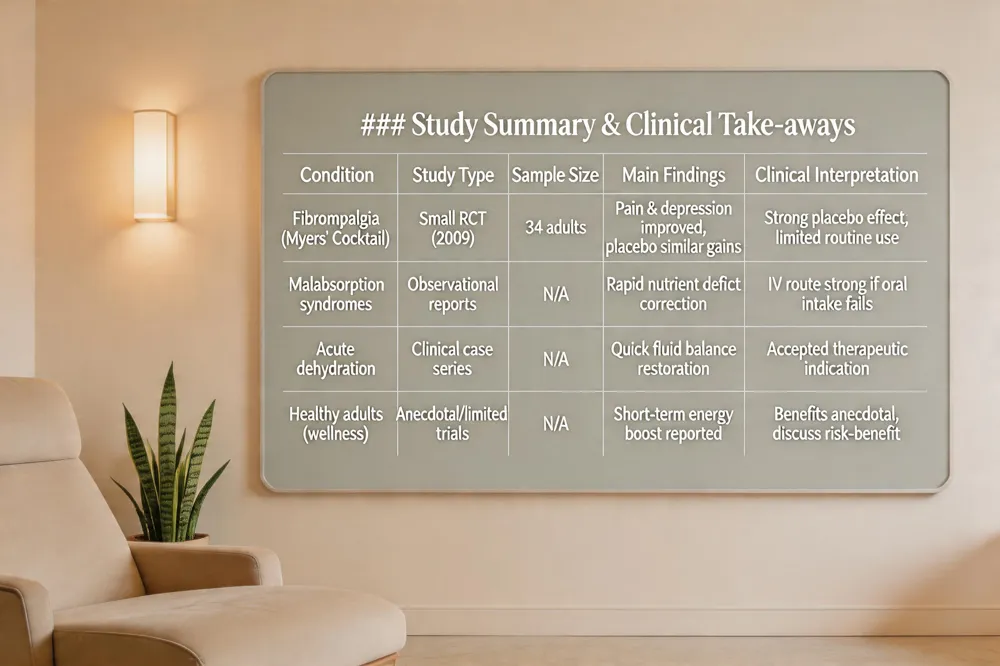 IV vitamin therapy, most often the “Myers’ Cocktail”, has been studied in a small 2009 trial of 34 adults with fibromyalgia. Participants reported reductions in pain, depression and improved quality of life, but the placebo group showed similar gains, highlighting a strong placebo effect and the limited size of the study. Larger, randomized trials are lacking, so clinicians view IV nutrients for fibromyalgia as a possible adjunct—especially when labs show deficiencies—rather than a proven cure.
Pros of IV vitamin therapy include rapid, nearly 100 % bioavailability, useful for patients with malabsorption, severe dehydration, or acute deficiencies. Patients often note short‑term boosts in energy, reduced fatigue and faster post‑exercise recovery. Cons are notable: sessions cost $250‑$800, are rarely covered by insurance, and high‑dose nutrients can cause kidney injury, electrolyte disturbances, vein inflammation, or rare allergic reactions.
Online communities such as Reddit echo this split view—some users rave about “instant energy,” while others criticize the price and occasional side‑effects like bruising.
Patient reviews from clinics like Jana HealthCare frequently praise friendly staff, comfortable settings and perceived improvements in sleep and well‑being, yet they also acknowledge that results vary and that the treatment should be discussed with a qualified health professional before becoming a regular wellness routine.
Guidelines and Best Practices for Safe Administration
Safety Checklist
| Step | Action |
|---|---|
| 1. Patient assessment | Review labs, allergies, contraindications |
| 2. Informed consent | Document risks, benefits, alternatives |
| 3. Sterile preparation | Use FDA‑registered or 503B‑compounded solutions |
| 4. Catheter selection | Smallest appropriate gauge, securement, site rotation |
| 5. Infusion rate | 20‑60 min; adjust for solution osmolarity |
| 6. Monitoring | Vital signs, site inspection every 5‑10 min |
| 7. Post‑infusion observation | 15‑30 min for immediate reactions |
| 8. Documentation | Record product, dose, time, adverse events |
 IV vitamin therapy guidelines – Safe treatment starts with a thorough patient assessment to uncover nutritional gaps, contraindications (e.g., renal disease, allergy) and to obtain informed consent. The infusion is prepared in a sterile, FDA‑registered or 503B‑compounded environment and administered by a qualified nurse or practitioner using aseptic technique. Doses follow evidence‑based protocols (high‑dose B‑complex, vitamin C, magnesium, calcium) adjusted for weight, age and clinical status, with infusion rates of 20‑60 minutes. Continuous monitoring for phlebitis, allergic reaction, electrolyte imbalance, and vital‑sign changes is required, followed by a brief post‑infusion observation. Detailed documentation of product, dose, time, patient response and any adverse events completes the safety checklist and ensures compliance with state regulations.
Management of IV complications – Immediate site assessment and catheter removal are the first steps. For phlebitis, elevate the limb, apply heat or cold, and give analgesics; infection warrants cultures and antibiotics. Infiltration is treated by stopping the infusion, removing the cannula, applying appropriate compresses, and monitoring tissue. Extravasation of vesicant agents requires rapid cessation, catheter removal, possible antidote (e.g., hyaluronidase), elevation and specialized dressing. Throughout, vital signs and fluid status are closely watched.
IV therapy complications and management – Common issues include infection, phlebitis, infiltration, extravasation, hematoma, thrombosis, fluid overload and air embolism. Early recognition through regular site inspection and vitals checks is crucial. Management involves catheter removal, aseptic dressing, targeted therapies (antibiotics, compresses, antidotes) and adjustment of infusion rates. Preventive strategies—appropriate catheter size, securement, site rotation, hand hygiene, and adherence to protocols—greatly reduce risk.
Systemic Complications and Emergency Management
Emergency Scenarios & Immediate Actions
| Complication | Warning Signs | First‑Line Management |
|---|---|---|
| Fluid overload / pulmonary edema | Dyspnea, frothy sputum, low O₂ sat | Elevate head, stop infusion, administer diuretics, call emergency services |
| Air embolism | Sudden chest pain, dyspnea, hypotension, altered mental status | Left lateral decubitus + Trendelenburg, 100 % O₂, emergency activation |
| Electrolyte disturbance (e.g., hyper‑K⁺) | Arrhythmia, muscle weakness, ECG changes | Stop infusion, correct electrolyte per protocol, cardiac monitoring |
| Anaphylaxis | Hives, wheezing, hypotension, facial swelling | Stop infusion, epinephrine IM, airway support, emergency care |
| Catheter‑related bloodstream infection | Fever, chills, purulent drainage, rigors | Remove catheter, obtain cultures, start broad‑spectrum antibiotics |
 Intravenous (IV) therapy delivers nutrients and fluids straight into the bloodstream, offering rapid benefits but also a set of systemic risks that require vigilant monitoring.
Fluid overload & pulmonary edema – When too much fluid is infused, especially in patients with heart or kidney disease, excess volume can seep into the lungs, causing shortness of breath, pink frothy sputum, and low oxygen levels. Prompt recognition, elevation of the head, diuretics, and temporary cessation of the infusion are essential.
Air embolism & emergency response – Even a small air bubble entering the venous line can block circulation, producing sudden chest pain, dyspnea, hypotension, and altered mental status. The immediate response is to place the patient in the left lateral decubitus and Trendelenburg position, administer 100 % oxygen, and seek emergency care.
Electrolyte disturbances & creatinine effects – Rapid shifts in potassium, magnesium, or calcium can trigger arrhythmias or neuromuscular weakness. IV fluids may dilute serum creatinine, giving a temporary drop in the lab value, but they do not treat underlying kidney injury. Careful dosing and renal monitoring prevent over‑correction.
Systemic complications of IV therapy – Metabolic imbalances, catheter‑related bloodstream infection, and rare anaphylaxis can arise. Early signs—fever, chills, rash, or hypotension—require immediate catheter removal and appropriate medical treatment.
IV complications infection – Breaches in aseptic technique lead to local redness, pain, and purulent drainage, progressing to sepsis if untreated. Strict hand hygiene, sterile dressings, and routine site checks are key preventive measures.
Can IV fluids lower creatinine levels? – Hydration improves renal perfusion and can dilute creatinine, causing a modest, temporary reduction in measured levels. This is not a cure for kidney dysfunction and must be guided by a clinician.
By integrating personalized medical oversight with holistic wellness practices—balanced nutrition, adequate sleep, and stress management—patients can safely enjoy the benefits of IV therapy while minimizing systemic risks.
Patient Experiences and Practical Tips
Practical Tips for First‑Time Recipients
| Tip | Details |
|---|---|
| Verify provider credentials | Ensure physician or board‑certified RN oversees infusion |
| Full disclosure | List all meds, supplements, allergies during screening |
| Hydration | Drink water before and after the session to aid vein health |
| Site monitoring | Check insertion site for pain, redness, swelling during and after infusion |
| Recognize systemic signs | Fever, chills, rapid heartbeat, shortness of breath → seek medical help |
| Set realistic expectations | Benefits may be modest; consider cost and evidence before scheduling regular sessions |
 Real‑world patient reviews of IV vitamin therapy are mixed but often highlight the setting and staff as key factors in a positive experience. Clients at clinics such as Jana HealthCare frequently describe a relaxed atmosphere, friendly personnel, and an immediate sense of increased energy, better sleep, and quicker recovery after workouts or illness. However, clinical research shows that in healthy individuals the benefits are modest at best and may be driven largely by a placebo effect; the therapy is truly indicated for people who cannot meet nutritional needs orally due to malabsorption, chronic alcoholism, or acute intoxication.
Online communities such as Reddit echo this variability. Some users report noticeable energy boosts and mood improvement, while others criticize the high cost (often $250–$800 per session) and occasional side effects like vein irritation, bruising, or mild allergic reactions. The consensus is that expectations should be realistic and based on personal health goals rather than marketing hype.
Practical advice for first‑time recipients includes: (1) verify that a qualified health professional—ideally a physician, nurse practitioner, or experienced RN—oversees the infusion; (2) disclose all medical conditions, medications, and allergies during the pre‑screening; (3) stay well‑hydrated before and after the session; (4) monitor the insertion site for pain, redness, swelling, or changes in flow, which could signal phlebitis, infiltration, or infection; and (5) be aware of systemic warning signs—fever, chills, rapid heart rate, shortness of breath, or chest pain—that require immediate medical attention.
In summary, IV therapy can be a pleasant adjunct to wellness when performed responsibly, but its disadvantages—high cost, limited evidence for healthy users, and potential complications such as infection, vein damage, allergic reactions, or nutrient toxicity—must be weighed carefully before committing to regular treatments.
Key Takeaways and Safe Choices
IV vitamin therapy can be appealing, but it carries real risks: infection or phlebitis at the insertion site, allergic reactions, fluid overload, electrolyte imbalances, and rare but serious complications such as air embolism or kidney injury from high‑dose nutrients. The likelihood of these events rises when the procedure is performed by untrained staff or in a spa without strict sterile protocols. For safety, always seek a qualified clinician—ideally a physician, nurse practitioner, or certified infusion nurse—who conducts a medical history, reviews medications, and monitors vital signs during and after the infusion. IV therapy should be reserved for genuine medical indications: severe malabsorption, postoperative dehydration, chronic alcohol misuse, or documented nutrient deficiencies that cannot be corrected orally. In healthy individuals, evidence for wellness benefits is limited, and lifestyle measures—balanced diet, regular exercise, adequate sleep, and stress management—remain the most reliable path to optimal health.