Introduction: The Rise of Laser Hair Removal
Laser hair removal has become one of the most requested cosmetic procedures in the United States, with thousands of patients seeking long‑lasting smoothness instead of daily shaving or waxing. Its popularity stems from the science of selective photothermolysis: a concentrated light wavelength is absorbed by melanin in the hair shaft and follicle, converting light energy into heat that damages the follicle while sparing surrounding skin. This precise targeting works best when there is high contrast between dark hair and light skin, allowing the laser to focus on pigment without harming epidermal melanin. Modern advances—longer wavelengths (Nd:YAG, diode) and cooling technologies—extend safety to darker skin tones and reduce discomfort. Effectiveness also depends on treating hairs in the active anagen growth phase, spacing sessions to capture new follicles, and adhering to pre‑ and post‑treatment care such as sun avoidance and proper shaving.
Science and Technology Behind Laser Hair Removal
Laser Types & Typical Use
| Laser | Wavelength (nm) | Ideal Skin Type | Ideal Hair Type | Key Points |
|---|---|---|---|---|
| Alexandrite | 755 | Light to olive (Fitzpatrick I‑III) | Dark, coarse | High melanin absorption, shallow depth |
| Diode | 800‑810 | All, best for medium‑dark | Thick, dark | Deeper penetration, good for body hair |
| Nd:YAG | 1064 | Darker (Fitzpatrick IV‑VI) | Any | Bypasses epidermal melanin, lower pigment‑damage risk |
| IPL (broad spectrum) | 500‑1200 | All, less precise | Light to medium | Covers wide range, less selective |
All systems use cooling (gel or contact) to protect epidermis.
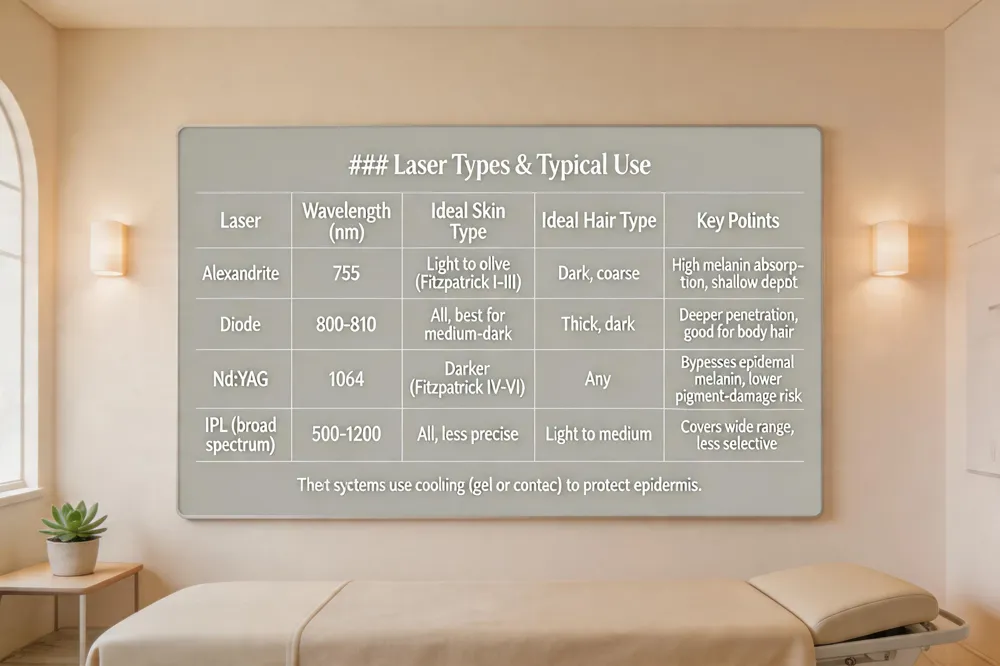 Laser hair removal relies on selective photothermolysis: a concentrated beam of light is absorbed by melanin in the hair shaft and follicle, converting light energy into heat that damages the growth‑producing cells while sparing surrounding skin. Because only hairs in the active anagen (growth) phase can be destroyed, multiple treatment sessions—typically every 4‑6 weeks—are scheduled to catch follicles as they enter this phase. Different laser wavelengths target melanin with varying depth and safety profiles: Alexandrite (755 nm) works well for light to olive skin with dark hair; Diode (800‑810 nm) penetrates deeper for thicker hair; Nd:YAG (1064 nm) uses a longer wavelength that bypasses epidermal melanin, making it safe for darker skin tones; IPL (500‑1200 nm) covers a broader spectrum but is less precise.
Facial skin benefits from the same principle: a cool gel or device protects the epidermis, the laser is fine‑tuned to the patient’s skin type and hair color, and a series of 4‑6 treatments yields long‑lasting reduction of fine, smoother skin.
Brazilian laser removal is especially effective because large spot sizes and overlapping passes treat the entire bikini area uniformly, and dual‑wavelength systems (e.g., Nd:YAG for darker skin, Alexandrite for lighter skin) maximize pigment absorption while minimizing hyperpigmentation. The result is rapid, precise targeting of dense, coarse hairs, leading to smoother, longer‑lasting hair‑free skin.
Treatment Protocols, Sessions, and Expected Results
Typical Protocols
| Body Area | Session Interval | Recommended Sessions | Expected Hair Reduction |
|---|---|---|---|
| Upper Lip | 4‑6 weeks | 4‑6 | 70‑90 % reduction |
| Underarms | 4‑6 weeks | 5‑7 | 80‑90 % reduction |
| Legs (full) | 6‑8 weeks | 6‑8 | 80‑90 % reduction |
| Back | 8‑12 weeks | 6‑8 | 70‑80 % reduction |
| Brazilian | 4‑6 weeks | 6‑8 | 80‑90 % reduction |
Maintenance: 1‑2 touch‑ups per year may be needed for optimal can.
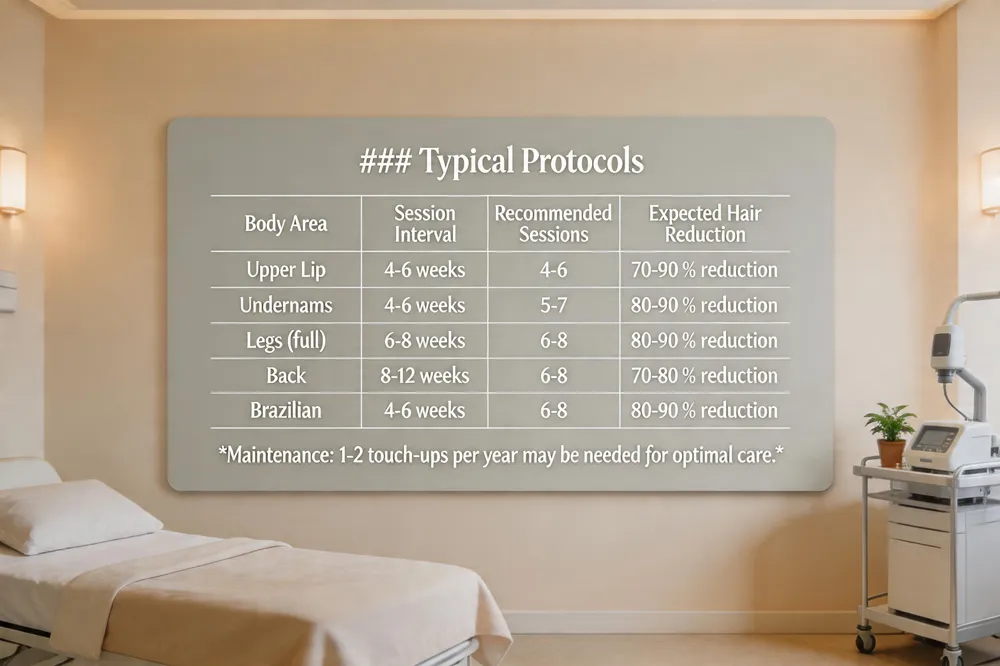 Laser hair removal works best when the hair follicle is in the active (anagen) growth phase, so a series of treatments is needed to catch follicles at different stages. Most patients require 4‑8 sessions, typically spaced 4‑8 weeks for fast‑growing areas such as the upper lip and 12‑16 weeks for slower‑growing regions like the back or legs. After a complete course, 70‑90 % of hair is permanently reduced, and any regrowth is usually finer and lighter. Because the hair does not disappear entirely, occasional maintenance touch‑ups—often once or twice a year—help sustain smooth skin.
How long do the results of laser hair removal typically last? Results can last several months to a few years; after 6‑8 sessions, most patients enjoy 80‑90 % reduction with occasional fine regrowth that may need yearly touch‑ups.
Can laser hair removal results last up to 10 years? Yes—many individuals experience near‑hairless skin for up to a decade, especially with periodic maintenance, though hormonal changes can cause some new growth.
Is laser hair removal permanent? It provides long‑term reduction, not 100 % permanence; follicles not in treatmentagen may reactivate, so maintenance may be required.
Benefits on the legs? Long‑lasting reduction, fewer ingrown hairs, smoother skin, less time spent shaving or waxing, and cost‑effective over years.
Benefits on the face? Precise, quick sessions eliminate daily shaving, reduce irritation and ingrown hairs, improve skin texture, and leave a clean, radiant complexion ready for makeup.
Safety, Side Effects, and Contraindications
Common & Rare Effects
| Effect | Frequency | Typical Duration | Management |
|---|---|---|---|
| Redness, swelling | Very common | Hours‑2 days | Cool compress, SPF 30+ |
| Stinging / warm‑pinprick | Common | Minutes‑Hours | Topical anesthetic if needed |
| Hyperpigmentation | Occasional (more in darker skin) | Weeks‑months | Sun avoidance, topical brighteners |
| Hypopigmentation | Rare | Weeks‑months | Sun protection, monitor healing |
| Blistering / scarring | Rare (improper settings) | Variable | Professional care, avoid aggressive settings |
Contraindications include active infection, recent tanning, and certain photosensitizing meds.
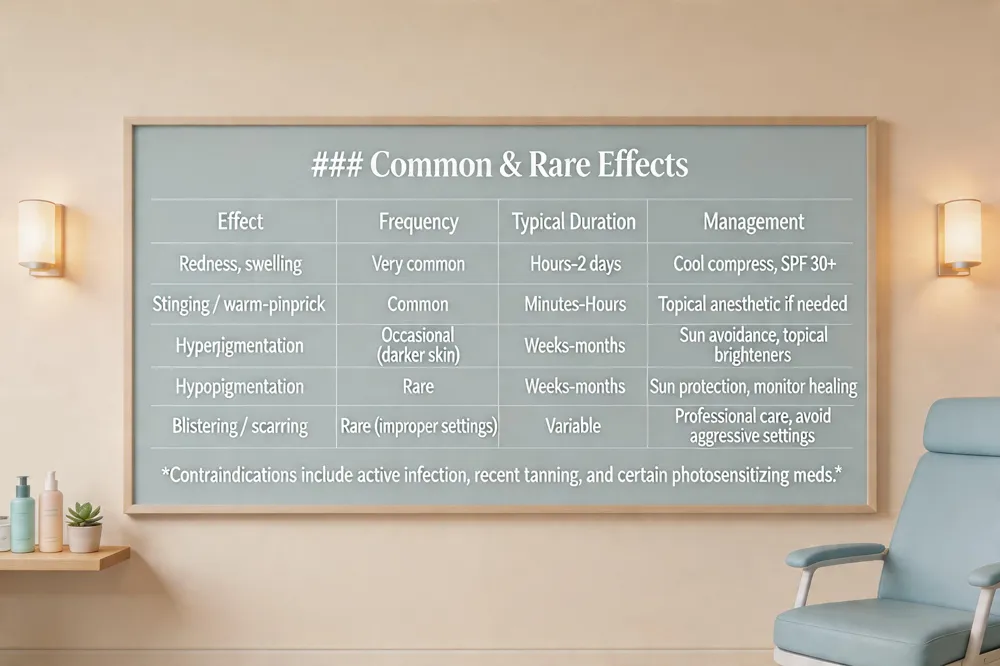 Laser hair removal is generally safe, but patients should know what to expect. The most common temporary side effects are mild redness, swelling, and a brief stinging or warm‑pinprick sensation that resolves within a few hours to a couple of days. Some people experience mild itching or tingling, and the treated skin becomes temporarily more photosensitive, so diligent SPF 30+ sunscreen use and sun avoidance are essential. Pigment changes—either darkening (hyperpigmentation) or lightening (hypopigmentation)—can occur, especially in darker‑skinned patients or when shorter‑wavelength lasers are used; these usually fade over weeks to months if sun exposure is minimized. Rare complications include blistering, crusting, or scarring, which are more likely when laser settings are inappropriate or the practitioner lacks training.
Current evidence shows no link between laser hair removal and cancer; the non‑ionizing light does not cause DNA damage. Patients with HSV‑2 can be treated safely as long as no active lesions are present and prophylactic antivirals are used if needed. Proper pre‑ and post‑care, performed by a licensed clinician, minimizes risks and maximizes lasting, smooth results.
Cost, Value, and Long‑Term Investment
Cost Overview (U.S.)
| Area | Avg. Cost per Session | Total (6‑8 sessions) | Long‑Term Note |
|---|---|---|---|
| Upper Lip | $50‑$80 | $300‑$640 | Low upfront, high ROI vs. razors |
| Underarms | $100‑$150 | $600‑$1,200 | Saves time & waxing costs |
| Full Legs | $400‑$600 | $2,400‑$4,800 | Cost‑effective vs. annual waxing |
| Back | $450‑$650 | $2,700‑$5,200 | Same principle as legs |
| Brazilian | $300‑$500 | $1,800‑$4,000 | Reduces recurring salon fees |
At‑home devices ($150‑$500) provide modest reduction and lack professional safety features.
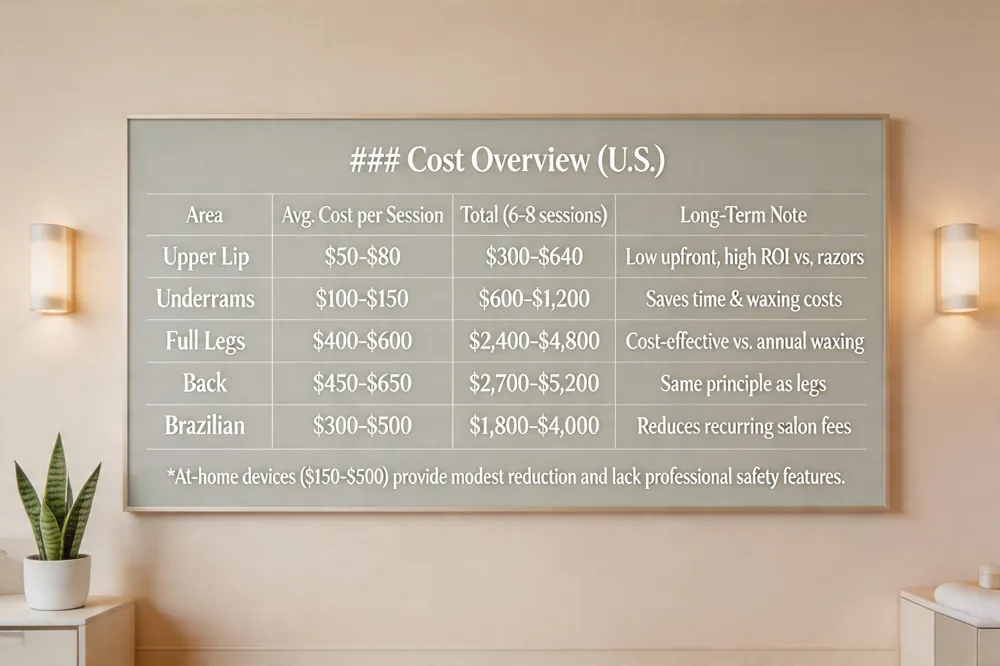 Laser hair removal pricing in the United States varies widely by treatment area and provider. A typical session can cost as little as $50 for a tiny spot (e.g., upper lip) and up to $600 for large zones such as full legs or the back. The national average falls between $200 and $900 per visit, and because most patients need 6‑8 sessions, total out‑of‑pocket expense ranges from roughly $500 for a small area to $3,000 + for extensive coverage. Factors that shift cost include geography (urban centers often charge more), the specific laser technology (Nd:YAG and diode systems for darker skin tones may be pricier), and the practitioner’s credentials (board‑certified dermatologists and experienced clinicians command higher fees).
When compared with lifelong shaving or waxing, laser hair removal proves cost‑effective: the cumulative expense on razors, creams, and salon waxes quickly exceeds the upfront investment, especially when maintenance sessions are infrequent. At‑home laser devices offer a lower‑initial outlay ($150‑$500) and convenience, but they deliver modest hair reduction and lack the safety testing of professional systems, making them best suited for supplemental upkeep rather than a primary solution.
Choosing a Provider and Preparing for Success
Provider Checklist
| Item | What to Verify |
|---|---|
| Credentials | Board‑certified dermatologist or licensed aesthetic physician |
| Device Clearance | FDA‑cleared laser (Alexandrite, Diode, Nd:YAG) |
| Experience | ≥ 2 years treating your Fitzpatrick skin type |
| Before‑and‑After Photos | Similar skin tone & hair color |
| Patient Reviews | Consistent safety & satisfaction scores |
| Consultation | Discussion of skin type, hair color, treatment plan |
Pre‑Treatment Prep: Stop waxing/plucking 4 weeks, shave day before, avoid sun/tanning 6 weeks, disclose meds (blood‑thinners, retinoids).
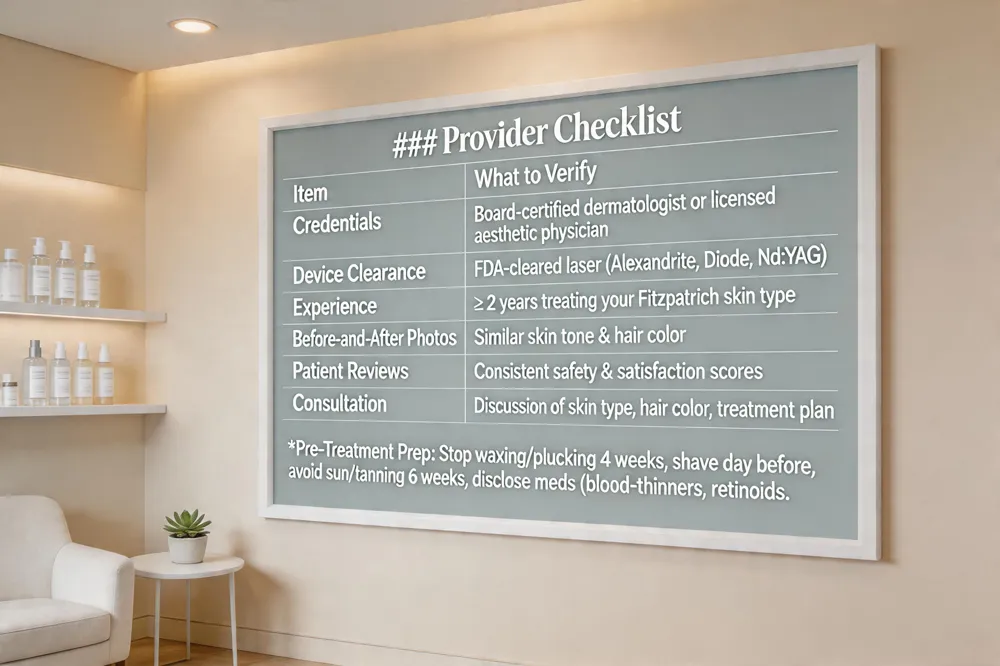 Finding a trustworthy laser‑hair‑removal clinic starts with looking for board‑certified dermatologists or licensed aesthetic physicians who hold a current New York State medical license. Verify that the practice uses FDA‑cleared devices (e.g., Alexandrite, Diode, or Nd:YAG lasers) and can show before‑and‑after photos of patients with skin tones similar to yours. Check online reviews on Google, Yelp, or RealSelf for consistent praise of safety, comfort, and results, and schedule a consultation to discuss your Fitzpatrick skin type, hair color, and treatment plan.
Before your first session, stop waxing or plucking for at least four weeks, shave the area hair day before, and avoid sun exposure or tanning beds for six weeks. Review any blood‑thinners, retinoids, or photosensitizing medications with your provider. Post‑treatment, cool the skin, apply soothing creams if needed, and use broad‑spectrum SPF 30 daily.
If you are unhappy with outcomes, return to the clinic for a follow‑up. The specialist may suggest additional touch‑up sessions, alternative methods such as electrolysis, or a custom after‑care regimen to address pigment changes or texture concerns.
Beyond Hair Reduction – Dermatologic Benefits
Additional Skin Benefits
| Benefit | How Laser Contributes |
|---|---|
| Fewer ingrown hairs | Follicle destruction eliminates hair‑in‑skin cycles |
| Smoother texture | Collagen remodeling from controlled heat |
| Minor fine‑line improvement | Stimulated fibroblasts boost elasticity |
| Reduced folliculitis & acne | Less follicular inflammation & bacterial colonization |
| Stable pigment tone | Proper wavelength & cooling minimize hyper/hypopigmentation |
These effects compound over multiple sessions, offering a holistic skin‑optimizing outcome.
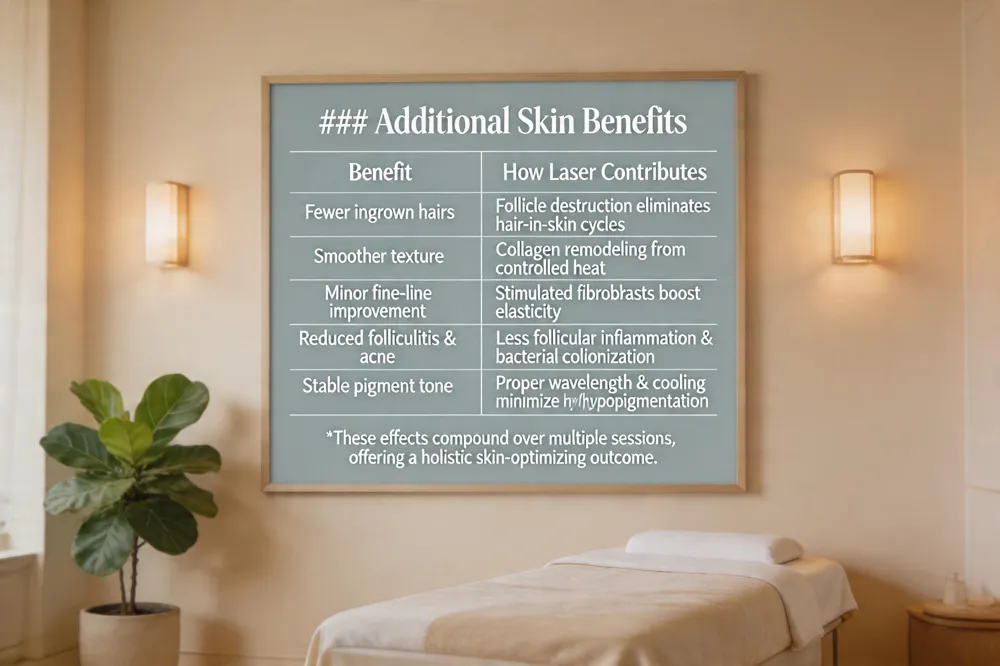 Laser hair removal does more than just diminish hair shafts; it delivers several dermatologic advantages that enhance overall skin health. First, by destroying the follicular root, the treatment virtually eliminates the cycle of ingrown hairs and razor‑bump formation that plague shaving and waxing, resulting in smoother, irritation‑free skin. Second, the controlled thermal effect stimulates mild collagen remodeling, which can improve texture, firmness and a subtle fine‑line reduction over time. Third, many patients report fewer episodes of folliculitis and even a modest decline in acne lesions because the laser’s precise targeting reduces inflammation and bacterial colonization around hair follicles. Finally, when performed with appropriate wavelength selection and cooling, pigment changes are minimal, helping maintain a stable skin tone and reducing the risk of post‑inflammatory hyper‑ or hypopigmentation. In summary, laser hair removal offers a comprehensive skin‑optimizing package: long‑lasting hair reduction plus smoother texture, better tone, and lower irritation, making it a valuable tool for both aesthetic and therapeutic skin care.
Conclusion: A Proven, Safe, and Worthwhile Choice
Laser hair removal works best when three key factors align: a high contrast between dark hair and light skin, treatment during the active anagen growth phase, and the use of appropriate laser wavelengths such as diode, alexandrite, or Nd:YAG. Modern devices that incorporate cooling, skin‑tone sensors and adjustable pulse settings further enhance safety and comfort. Because the procedure relies on precise physics, it should be performed by board‑certified dermatologists or experienced laser technicians who can tailor settings to each patient’s Fitzpatrick skin type, hair color and hormonal profile. In Brooklyn, where busy lifestyles demand lasting smoothness, the long‑term value is clear—fewer weekly razors, reduced ingrown‑hair irritation, and a lasting confidence boost. Investing in a qualified provider delivers durable hair reduction, minimizes side‑effects, and offers a personalized, wellness‑focused plan that pays off for years to come and overall skin health.