Understanding Laser Hair Removal’s Long‑Term Impact
Laser hair removal works through selective photothermolysis: a concentrated beam of light is absorbed by melanin in the hair shaft, converting light energy into heat that damages the follicle without harming surrounding skin. This targeted damage impairs the follicle’s ability to regenerate hair, especially when the hair is in its active (anagen) growth phase. The procedure is FDA‑cleared for permanent hair reduction on many body sites, and the FDA’s rigorous safety standards require that devices be tested for consistent energy delivery, skin‑type compatibility, and minimal risk of burns or pigment changes. In the United States, a typical regimen consists of 4‑8 sessions, each spaced 4‑8 weeks apart; small areas such as the upper lip may take only a few minutes per visit, while larger regions like legs or back can require up to an hour. After completing the series, most patients experience a 70‑90 % reduction in visible hair, and regrowth is usually finer and lighter. The benefits extend beyond a smooth, hair‑free surface: reduced ingrown hairs, fewer razor burns, improved skin texture, and even collagen stimulation contribute to healthier‑ and skin and by cosmetic,term providing treatment more wellness and aesthetic makingterm maintenance}‑ maintenanceterm of more.
How the Technology Works and Why It’s Safer Than Ever
| Feature | Description |
|---|---|
| Selective photothermolysis | Concentrated light is absorbed by melanin in the hair follicle, converting to heat that damages the follicle while sparing surrounding skin. |
| Laser types | Diode, Alexandrite, Nd:YAG – each offers different wavelengths to match skin tone and hair color, expanding safety for darker complexions and lighter hair. |
| FDA clearance & provider qualifications | All devices used in the U.S. are FDA‑cleared and must be operated by board‑certified dermatologists, plastic surgeons, or trained aestheticians under physician supervision. |
| Cooling technologies | Dynamic cooling devices, contact cooling, and precise pulse‑duration controls reduce discomfort and protect the epidermis. |
| Safety outcomes | Mild, temporary side effects (redness, swelling, tingling) resolve within hours‑days; serious complications are rare. |
 Laser hair removal works through selective photothermolysis: a concentrated beam of light is absorbed by melanin in the hair follicle, converting light to heat that damages the follicle while sparing surrounding skin. Modern systems—diode, alexandrite, and Nd:YAG lasers—offer a range of wavelengths that can be matched to a patient’s skin tone and hair color, expanding safety for darker complexions and lighter hair. All devices used in the United States are FDA‑cleared and must be operated by board‑certified dermatologists, plastic surgeons, or trained aestheticians under physician supervision, ensuring strict adherence to safety protocols. Advances such as dynamic cooling devices, contact cooling, and precise pulse‑duration controls further reduce discomfort and protect the epidermis.
Is laser hair removal safe? Yes. When performed by qualified professionals, side effects are mild and temporary—redness, swelling, or a brief tingling that resolves within hours to days. Serious complications are rare.
Permanent laser hair removal side effects cancer? No evidence links the non‑ionizing laser energy to cancer; the FDA considers the procedure safe.
Is laser hair removal better now than 20 years ago? Absolutely. Modern lasers deliver longer wavelengths, shorter pulses, and built‑in cooling, allowing treatment of diverse skin tones with less pain and fewer sessions.
What lasers does Jennifer Aniston use? She prefers the Clear + Brilliant® fractional laser, a non‑ablative, FDA‑approved device that stimulates collagen without significant downtime.
Clinical Efficacy: How Much Hair Is Gone and For How Long?
| Body Area | Expected Hair Reduction | Typical Duration of Effect | Notes |
|---|---|---|---|
| Legs / Back | 70‑90 % | Several months to years; often 2‑5 years before mild maintenance. | |
| Bikini line | 75‑90 % | 2‑5 years before a touch‑up. | |
| Facial zones (upper lip, chin, eyebrows) | 70‑90 % | May require annual touch‑ups due to hormonal influences. | |
| Overall | 70‑90 % after a full series (5‑8 sessions) | Regrowth, when it occurs, is finer and lighter; annual or bi‑annual maintenance keeps smooth skin. |
 Results vary by body area. Larger zones such as legs or back often retain reduction for several months to years, while facial zones may need annual touch‑ups because hormonal influences are stronger. The bikini line, for example, usually maintains a 75‑90 % reduction for 2‑5 years before a mild maintenance session is required. Some patients enjoy smooth skin for up to a decade when hormone levels remain stable and after‑care (shaving between sessions, sun protection, SPF 30+) is followed.
Long‑term outcomes depend on skin‑to‑hair contrast, laser type (diode, Alexandrite, Nd:YAG), and individual hormonal changes. Annual or bi‑annual maintenance appointments keep the skin smooth, reduce ingrown hairs, and preserve the aesthetic benefits achieved through the initial treatment course.
Skin‑Health Benefits That Go Beyond Hair Reduction
| Benefit | Details |
|---|---|
| Long‑term facial benefits | Reduced hair growth, fewer ingrown hairs, smoother complexion, simplified skincare routine. |
| At‑home laser benefits | Consistent use weakens follicles, decreasing regrowth and shaving‑related irritation, saving time and money. |
| Hair‑loss skin effects | Short‑term redness and occasional reversible pigment changes; serious complications are rare when performed by qualified professionals. |
 Long‑term facial benefits – After a full series, patients enjoy years of reduced hair growth, fewer ingrown hairs, and a smoother, more even complexion, enhancing confidence and simplifying skincare routines.
At‑home laser benefits – Consistent use weakens follicles, decreasing regrowth and minimizing shaving‑related irritation, saving time and money while supporting smoother skin.
Hair‑loss skin effects – The procedure’s primary skin effects are short‑term redness and occasional pigment changes, both usually reversible. Serious complications are rare when performed by qualified professionals.
Side Effects, Management and What to Expect
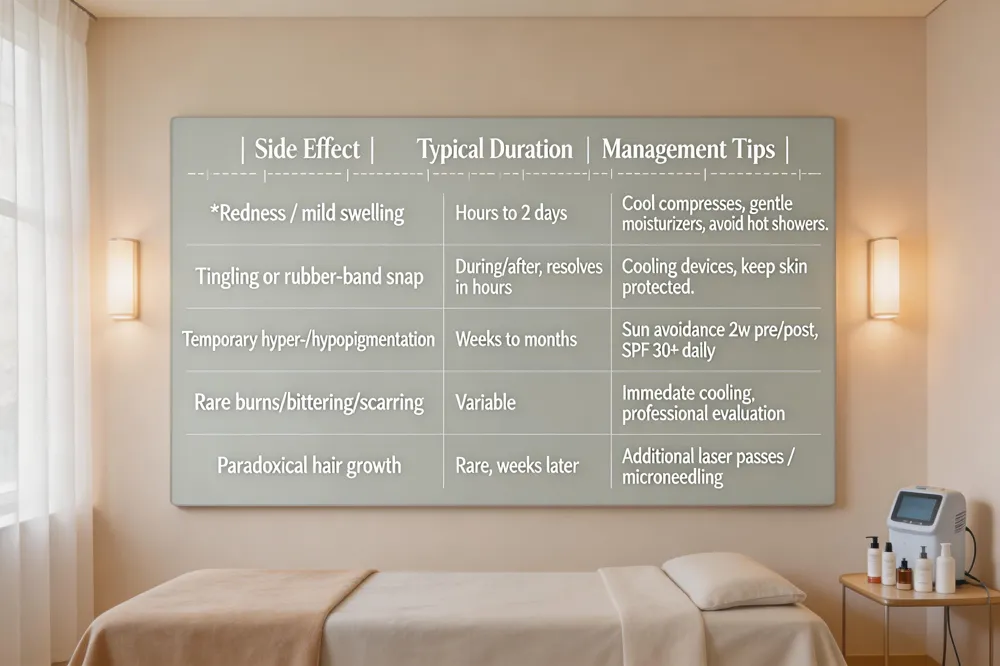
| Side Effect | Typical Duration | Management Tips |
|---|---|---|
| Redness / mild swelling | Hours to 2 days | Cool compresses, gentle moisturizers, avoid hot showers. |
| Tingling or rubber‑band snap sensation | During/after treatment, resolves within hours | Use cooling devices, keep skin protected. |
| Temporary hyper‑/hypopigmentation | Weeks to months (usually resolves) | Strict sun avoidance 2 weeks pre/post, SPF 30+ daily, follow provider’s cooling protocol. |
| Rare burns, blistering, scarring | Variable | Immediate cooling, professional evaluation, avoid excessive fluence. |
| Paradoxical hair growth | Rare, may appear weeks later | Additional laser passes or combination therapies (e.g., microneedling). |
 Laser hair removal is a low‑risk, minimally invasive procedure, but patients should be aware of the typical short‑term reactions and the steps to keep them mild.
Common temporary reactions – Most people experience brief redness, mild swelling, and a tingling or rubber‑band snap sensation during and after treatment. These effects usually resolve within a few hours to two days. Cool compresses, gentle moisturizers, and avoiding hot showers can soothe the skin.
Pigment changes and prevention – Temporary hyper‑ or hypopigmentation can occur, especially in darker‑skinned individuals or when sun protection is inadequate. To minimize this risk, patients should (a) stay out of direct UV for at least two weeks before and after each session, (b) use a broad‑spectrum SPF 30+ daily, and (c) follow the provider’s cooling and post‑care guidelines.
Rare complications – Improper settings or insufficient cooling may cause superficial burns, blistering, scarring, or, in very uncommon cases, paradoxical hair growth. These events are uncommon when treatment is performed by licensed dermatologists or trained medical professionals using FDA‑cleared devices.
Addressing regret – If a patient feels dissatisfied, a follow‑up with the treating clinician is essential. The provider can evaluate any lingering redness, pigment alteration, or residual hair and offer corrective options such as additional laser passes, topical agents, or combination therapies (e.g., microneedling). Open communication and realistic expectations—laser offers long‑term reduction, not absolute permanence—help ensure a positive outcome.
Financial Perspective: Cost, Value and Long‑Term Savings
| Service | Cost per Session (NYC) | Package Discount (6‑8 sessions) | Long‑Term Savings vs. Razors/Waxing |
|---|---|---|---|
| Upper lip / chin / eyebrows | $45‑$75 | 20‑30 % off per‑session rate when bundled | Saves $200‑$400 over 5‑year period compared to daily shaving. |
| Full legs / full back | $300‑$350 | 20‑30 % off per‑session rate when bundled | Saves $1,200‑$1,800 over 5‑year period versus waxing appointments. |
| Laser type impact | Diode (most affordable) | – | Suitable for dark hair on lighter skin; lower upfront cost. |
| Nd:YAG / Alexandrite | Slight premium | – | Safer for darker complexions; cost offset by fewer complications. |
| Overall cost‑effectiveness | Up‑front cost spread over years | – | Comparable to or less than cumulative annual expense of razors, creams, waxing, and depilatories. |
 Laser hair removal cost varies by body area, laser type and treatment package. In the New York City market, small facial zones such as the upper lip, chin or eyebrows typically run $45‑$75 per session, while larger regions like full legs or a full back are quoted $300‑$350 per visit. Clinics—including those in Brooklyn—offer both session‑by‑session pricing and discounted bundles of 6‑8 treatments; buying a package can shave 20‑30 percent off the per‑session rate because the total number of sessions needed for a 70‑90 % hair‑reduction (usually 6‑9) is known up front. Diode lasers, which excel on dark hair and lighter skin, are generally the most affordable option; Nd:YAG and alexandrite systems, prized for safety on darker complexions, may carry a modest premium. When the upfront price is spread over years, laser hair removal becomes cost‑effective compared with the perpetual expense of razors, shaving creams, waxing appointments and chemical depilatories. Most U.S. insurance plans deem the procedure cosmetic, so out‑of‑pocket payment is standard, but reputable practices such as Jana HealthCare provide transparent quotes with no hidden fees, ensuring you can budget confidently for a lasting, low‑maintenance solution.
Special Populations and Individual Considerations
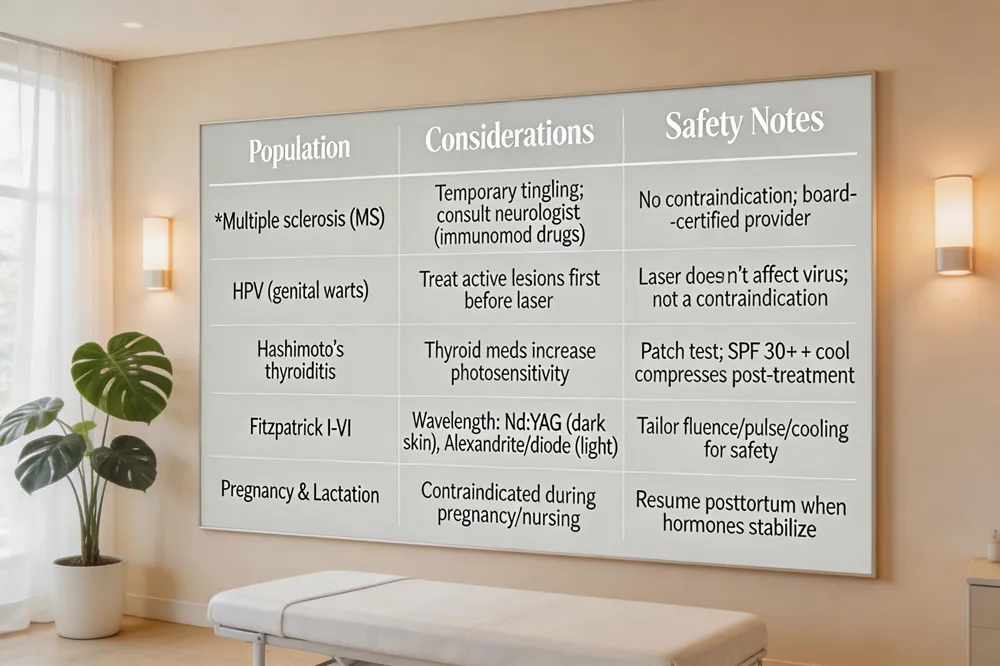
| Population | Considerations | Safety Notes |
|---|---|---|
| Multiple sclerosis (MS) | May experience temporary tingling; discuss with neurologist especially if on immunomodulatory drugs. | No direct contraindication; choose board‑certified provider. |
| HPV (genital warts) | Active lesions should be treated separately before laser work. | Laser does not affect the virus; not a contraindication. |
| Hashimoto’s thyroiditis | Some thyroid meds increase photosensitivity. | Patch test recommended; use SPF 30+ and cool compresses post‑treatment. |
| Fitzpatrick skin types I‑VI | Wavelength selection critical: Nd:YAG for darker skin, Alexandrite/diode for lighter skin. | Tailored fluence, pulse duration, and cooling maximize safety. |
| Pregnancy & lactation | Contraindicated during pregnancy and while nursing. | Resume treatment postpartum once hormonal levels stabilize. |
 Can MS patients do laser hair removal?
Yes. Most people with multiple sclerosis (MS) can safely undergo laser‑hair‑removal treatments. The laser’s concentrated light targets melanin in hair follicles and does not affect the nervous system, so there is no direct medical contraindication. A small number of patients report temporary tingling or numbness in the treated area, which usually resolves within a few days. It is prudent to discuss the procedure with your neurologist, especially if you are on immunomodulatory drugs or have active disease activity, and to choose a board‑certified provider who can tailor settings to your skin type.
Can MS patients do laser hair removal?
Yes. Most people with multiple sclerosis (MS) can safely undergo laser‑hair‑removal treatments. The laser’s concentrated light targets melanin in hair follicles and does not affect the nervous system, so there is no direct medical contraindication. A small number of patients report temporary tingling or numbness in the treated area, which usually resolves within a few days. It is prudent to discuss the procedure with your neurologist, especially if you are on immunomodulatory drugs or have active disease activity, and to choose a board‑certified provider who can tailor settings to your skin type.
Can I get laser hair removal if I have HPV? HPV resides in the superficial layers of skin and mucosa; laser hair removal does not penetrate deep enough to affect the virus. Having HPV is not a contraindication, but any active genital wart lesions should be treated separately (e.g., electrocautery) before cosmetic laser work proceeds.
Can you get laser hair removal with Hashimoto’s? Hashimoto’s thyroiditis itself does not prevent laser treatment, but some thyroid medications can increase photosensitivity, heightening the risk of post‑procedure redness or mild irritation. A brief patch test and careful after‑care (cool compresses, SPF‑30 sunscreen) are advisable.
Skin‑type specific laser selection Modern devices (diode, Alexandrite, Nd:YAG) allow safe treatment across Fitzpatrick I‑VI. Darker skin benefits from longer‑wavelength Nd:YAG lasers, while lighter skin responds well to Alexandrite or diode systems. Tailoring wavelength, fluence, and pulse duration maximizes efficacy and minimizes pigmentary changes.
Hormonal influences and pregnancy Hormonal fluctuations (pregnancy, menopause, PCOS) can trigger new hair growth making periodic touch‑up sessions (once or twice yearly) useful. Laser hair removal is contraindicated during pregnancy and lactation; treatment should resume after the postpartum period once hormonal levels stabilize.
Myths, Misconceptions and Frequently Asked Concerns
| Myth | Fact |
|---|---|
| Laser hair removal causes infertility | No effect on fertility; laser targets only melanin in superficial skin layers. |
| Laser treatments increase cancer risk | Lasers emit non‑ionizing energy; no causal link to skin cancer documented over two decades of FDA‑cleared use. |
| Results are permanent | Provides lasting reduction (70‑90 % hair density) after 5‑8 sessions; regrowth is finer and requires annual touch‑ups. |
| Procedure is unsafe | When performed by licensed professionals with FDA‑cleared devices, side effects are mild and temporary; proper pre‑/post‑care further minimizes risk. |
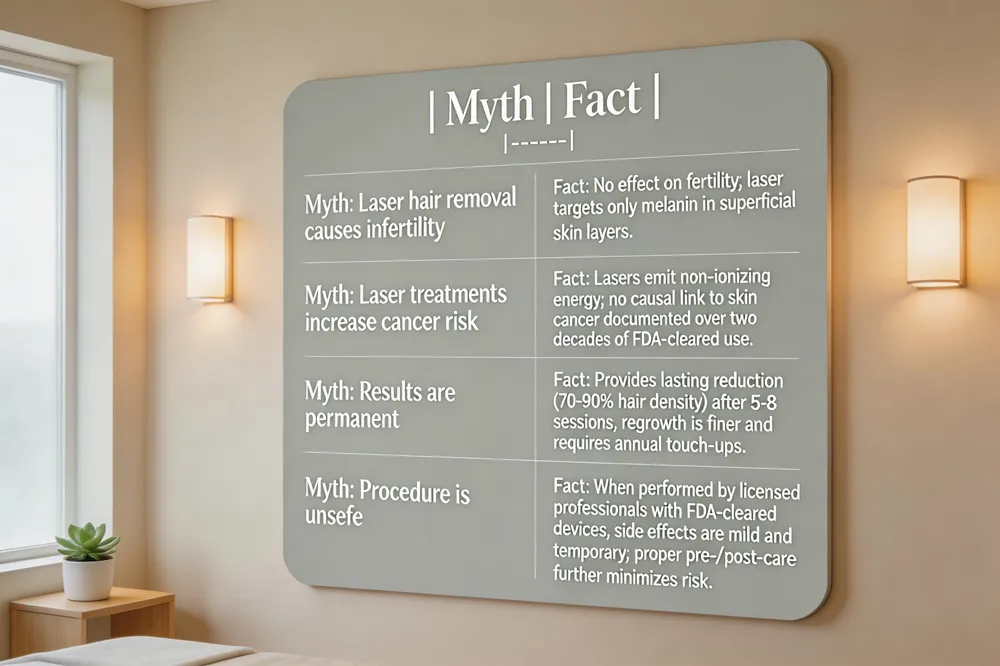 Infertility myth – Laser hair removal does not affect fertility. The technology uses non‑ionizing light that targets melanin in hair follicles only within the epidermis and superficial dermis. No radiation reaches the reproductive organs, and clinical reviews have found zero correlation between laser treatments (whether on the bikini line, Brazilian area, or any other zone) and reduced fertility in men or women. The only reported side effects are localized skin reactions such as temporary redness, swelling, or pigment changes.
Cancer risk clarification – The lasers employed for hair reduction emit non‑ionizing energy, which cannot cause DNA damage in the way ionizing radiation (X‑rays, UV) does. Over two decades of FDA‑cleared use, no causal link to skin cancer has been documented. Minor side effects may include temporary erythema or pigment alteration, but the risk of melanoma or other cancers is not supported by scientific evidence.
Long‑term permanence expectations – Laser hair removal is not "permanent" in the absolute sense, but it delivers lasting hair reduction. Multiple sessions (typically 5‑8, spaced 4‑8 weeks apart) target follicles in the active growth phase; most patients experience a 70‑90 % decrease in hair density after a full series. Regrowth, when it occurs, is finer and lighter, and annual touch‑ups maintain smooth skin.
General safety reassurance – When performed by licensed dermatologists, plastic surgeons, or trained aestheticians under physician supervision, the procedure is low‑risk. Temporary redness or swelling resolves within hours to a day, and proper pre‑ and post‑care (sun avoidance, sunscreen, gentle moisturizers) further minimizes any irritation. Overall, laser hair removal is a safe, effective, and long‑lasting solution for smoother, hair‑free skin.
Embracing the Full Spectrum of Laser Hair Removal Benefits
Laser hair removal offers more than a smooth, hair‑free look; it delivers long‑term hair reduction that translates into healthier skin. By targeting melanin in the follicle, the laser disables future growth, so after a typical 4‑8‑session series patients in the 70‑90 % decrease in hair density observed by the American Society of Plastic Surgeons and other U.S. studies. The remaining regrowth is finer, lighter, and less likely to cause ingrown hairs, razor burn, or folliculitis, resulting in a more even tone and reduced hyperpigmentation.
Safety is paramount. FDA‑cleared devices such as diode, alexandrite, and Nd:YAG lasers are used by licensed dermatologists, plastic surgeons, or trained aestheticians under physician supervision. Modern systems include cooling mechanisms and adjustable wavelengths that protect all skin tones—from light to darker Fitzpatrick categories—while minimizing temporary redness, swelling, or pigment changes. The upfront cost is offset over years by eliminating daily razors, shaving creams, and wax appointments, making laser hair removal a cost‑effective, low‑maintenance solution.
Personalized care plans consider hair color, skin type, hormonal influences, and lifestyle to schedule sessions every 4‑8 weeks and plan annual touch‑ups. This future‑proofs grooming routines, freeing patients from frequent maintenance and allowing them to focus on broader wellness and aesthetic goals.