Understanding PRP in Aesthetic Dermatology
Platelet‑rich plasma (PRP) is an autologous concentrate made from a small draw of the patient’s own blood. After a brief centrifugation, the platelet‑rich layer—packed with growth factors such as PDGF, TGF‑β, VEGF, and EGF—is injected into the dermis. These molecules activate fibroblasts, boost collagen and elastin synthesis, and promote angiogenesis, which together improve skin texture, firmness, and elasticity while reducing fine lines and mild scarring. Because the product is derived from the individual’s blood, allergic reactions are virtually absent. Common side effects are mild and transient—brief redness, swelling, bruising, or tenderness that resolve within a few days. Rare complications can include infection or vascular occlusion if aseptic technique is breached, so treatment should be performed by a qualified, board‑certified dermatologist. Typical protocol: three to four sessions 4‑6 weeks apart, with maintenance every 6‑12 months.
Clinical Benefits of PRP for Facial Rejuvenation
Key Benefits of PRP for Facial Rejuvenation
| Benefit | Mechanism | Typical Timeline |
|---|---|---|
| Increased collagen density | PDGF, TGF‑β, VEGF, EGF stimulate fibroblasts | 4‑6 weeks (initial), peak at 3‑4 months |
| Improved elasticity & firmness | Enhanced elastin production | 4‑6 weeks onward |
| Fine‑line softening & natural lift | Intradermal volume restoration | 4‑6 weeks onward |
| Scar remodeling (acne, post‑procedure) | Accelerated neocollagenesis when combined with microneedling/laser | 2‑4 weeks after each session |
| Minimal allergic risk | Autologous product | Immediate |
| Transient bruising/edema | Minor post‑procedure effect | Resolve within a few days |
Results are typically maintained with 3–6 sessions spaced 4‑6 weeks apart, followed by yearly touch‑ups.
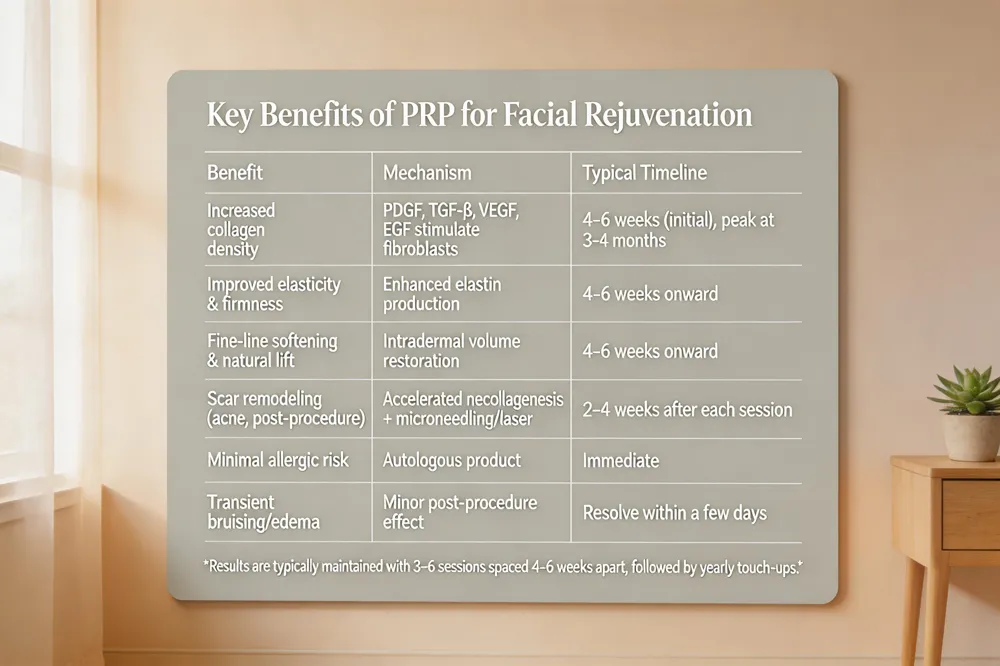 Platelet‑rich plasma (PRP) therapy uses a concentrated sample of your own blood platelets to deliver growth factors that stimulate collagen and elastin production, leading to firmer, more youthful skin. The high‑dose PDGF, TGF‑β, VEGF and EGF activate fibroblasts, increasing dermal collagen density by up to 90 % in clinical studies and improving texture, tone and elasticity. By injecting PRP into the mid‑dermis, fine lines soften and lost volume is naturally “filled,” giving a subtle lift without synthetic fillers. PRP also supports scar remodeling; when combined with microneedling or laser resurfacing it accelerates neocollagenesis, reducing acne‑scar depth and post‑procedure downtime. Because the product is autologous, allergic reactions are rare and side effects are limited to mild bruising or edema that resolve in a few days. Visible results appear within 4‑6 weeks, peak at 3‑4 months and can be maintained with 3–6 sessions spaced 4‑6 weeks apart, followed by yearly touch‑ups. Patients report high satisfaction, noting brighter complexion, improved hydration, and a natural glow that complements a balanced skincare routine and lasting.
What to Expect Before, During, and After a PRP Session
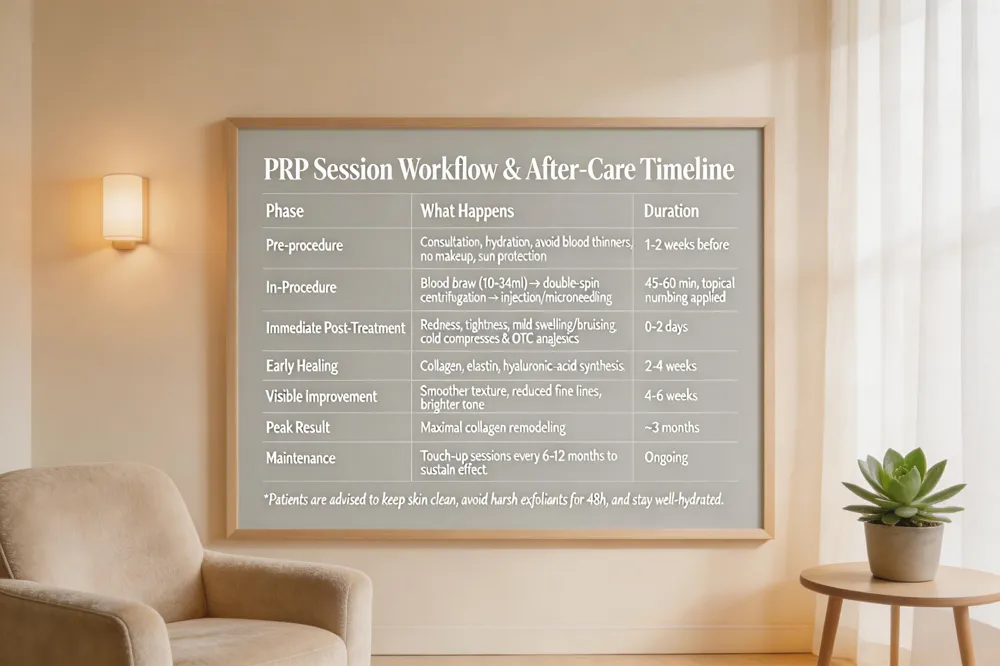
PRP Session Workflow & After‑Care Timeline
| Phase | What Happens | Duration |
|---|---|---|
| Pre‑procedure | Consultation, hydration, avoid blood thinners, no makeup, sun protection | 1‑2 weeks before |
| ** in | Blood draw (10‑34 ml) → double‑spin centrifugation → intradermal injection or microneedling | 45‑60 min total, topical numbing applied |
| Immediate post‑treatment | Redness, tightness, mild swelling/bruising; can be soothed with cold compresses & OTC analgesics | 0‑2 days |
| Early healing | Collagen, elastin, hyaluronic‑acid synthesis ramps up | 2‑4 weeks |
| Visible improvement | Smoother texture, reduced fine lines, brighter tone | 4‑6 weeks |
| Peak result | Maximal collagen remodeling | ~3 months |
| Maintenance | Touch‑up sessions every 6‑12 months to sustain effect | Ongoing |
Patients are advised to keep skin clean, avoid harsh exfoliants for 48 h, and stay well‑hydrated.
 Pre‑procedure preparation
A brief consultation determines your skin goals, and you’ll be asked to stay well‑hydrated, avoid blood‑thinners, excessive sun, and any makeup on the day of treatment. Clean, makeup‑free skin is essential.
Procedure steps
A small volume of blood (10‑34 ml) is drawn, anticoagulated, and double‑spun in a centrifuge to isolate platelet‑rich plasma (PRP). The PRP is either injected intradermally with a fine‑gauge needle or applied during microneedling. The process typically takes 45‑60 minutes and is performed under topical numbing.
Immediate post‑treatment effects
Right after the session the skin may appear red, feel tight, and show mild swelling or bruising. These transient signs usually resolve within a few days and can be eased with cold compresses and OTC pain relievers.
Timeline of results
Collagen, elastin, and hyaluronic‑acid production increase over the next 2‑4 weeks, yielding smoother texture, reduced fine lines, brighter tone, and improved firmness. Visible benefits appear by 4‑6 weeks, peak around 3 months, and typically last 6‑12 months. Maintenance sessions every 6‑12 months help sustain the rejuvenated appearance.
Cost and Value of PRP Treatments
Cost Overview & Value Considerations for PRP Facials
| Item | Typical Price (U.S.) | Notes |
|---|---|---|
| Single PRP session | $500 – $1,500 | Varies by region & clinic |
| Standard NY clinic avg. | ≈ $1,000 | |
| Recommended series (2‑4 sessions) | $1,000 – $4,000 total | Best outcomes with multiple treatments |
| Package deal (3‑session bundle) | $1,300 – $1,600 | Lower per‑session cost |
| Optional add‑ons (microneedling, kits) | $100 – $300 each | Enhances results |
| Financing/Payment plans | Interest‑free options often available | Reduces upfront burden |
| Insurance coverage | None (cosmetic) | Out‑of‑pocket expense |
When budgeting, include post‑procedure skincare products and any follow‑up visits.
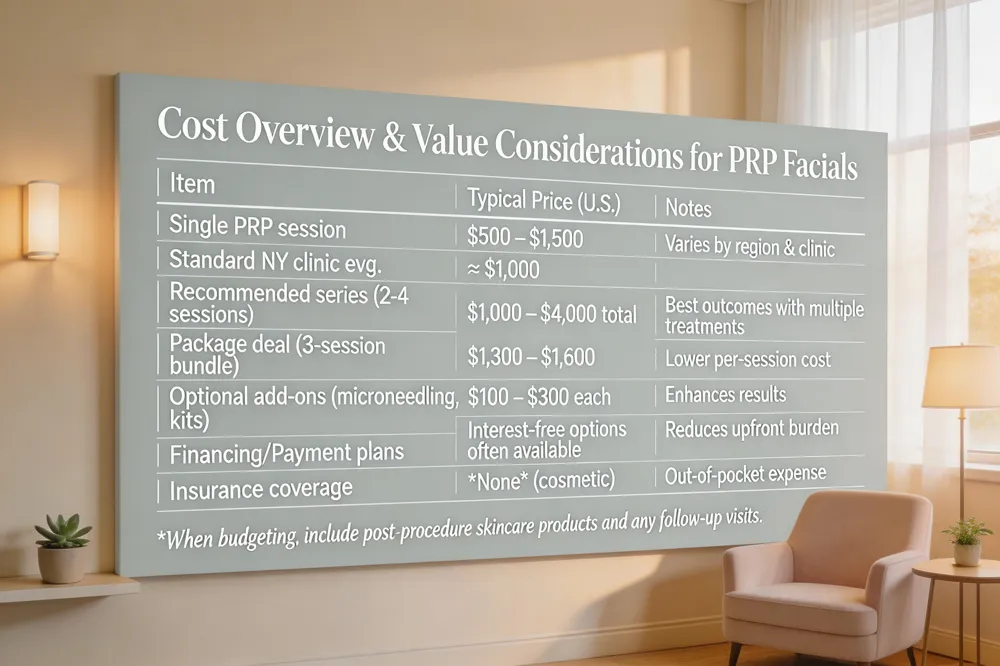 [Platelet‑rich plasma (PRP) facial rejuvenation] is a personalized, autologous therapy that leverages your own growth factors to stimulate collagen, improve texture, and diminish fine lines. In the United States the price per session typically falls between $500 and $1,500, with many New‑York clinics pricing a standard treatment around $1,000. Because optimal outcomes usually require a series of injections, patients often plan for 2–4 sessions, bringing the total investment to roughly $1,000–$4,000. Many practices offer discounted package deals—such as three‑session bundles for $1,300‑$1,600—or membership plans that lower the per‑session cost. PRP is considered a cosmetic procedure, so insurance does not cover it; however, clinics frequently provide financing options, interest‑free payment plans, and promotional discounts to make the out‑of‑pocket expense more manageable. When budgeting, consider additional fees for blood‑draw kits, optional microneedling, and post‑procedure skincare products.
Safety, Side Effects, and Contraindications
Safety Profile & Contraindications for PRP
| Aspect | Details |
|---|---|
| Common mild adverse events | Bruising, swelling, redness, tenderness; resolve within a few days |
| Rare serious complications | Bacterial infection (requires antibiotics), inadvertent vascular injection (possible vision loss), inflammatory nodules/granulomas (may need steroids) |
| Allergic reactions | Uncommon; possible to anticoagulants or additives |
| Contraindications | Active infection, platelet disorders, severe thrombocytopenia, uncontrolled systemic disease, ongoing anticoagulant therapy, history of deep‑vein thrombosis |
| Safety measures | Strict aseptic technique, proper centrifugation, precise injection placement, patient monitoring for pain/swelling/infection |
| When to seek help | Persistent pain, increasing swelling, fever, or any signs of infection |
Overall, PRP is well‑tolerated when performed by trained professionals.
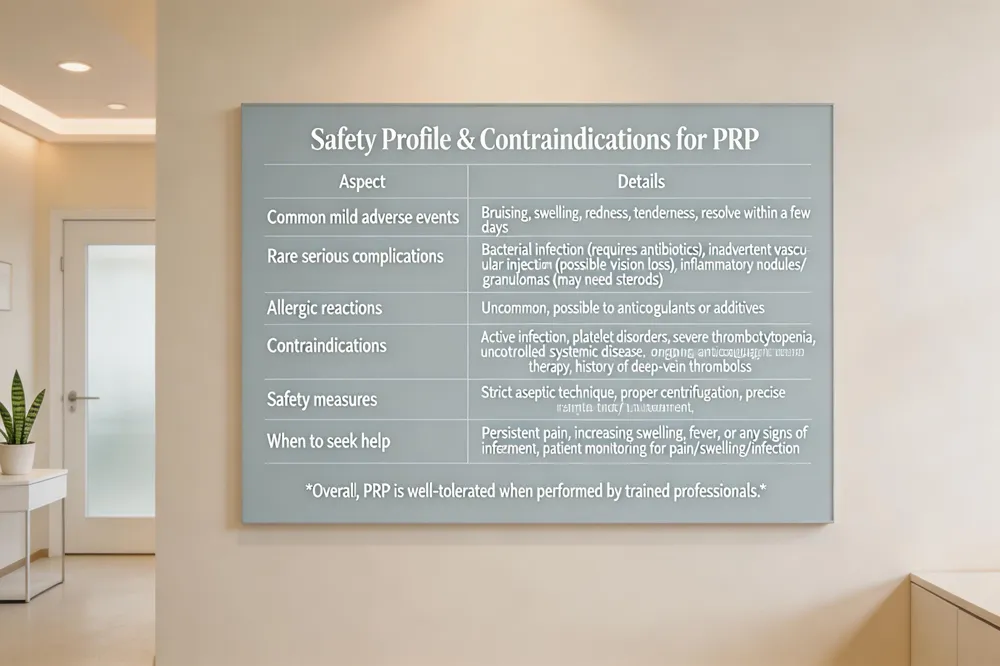 Platelet‑rich plasma (PRP) injections for cosmetic dermatology are generally well‑tolerated. The most common adverse events are mild, short‑term reactions such as bruising, swelling, redness, and tenderness at the injection sites, typically resolving within a few days. Occasionally patients report itching or a slight soreness from needle penetration. Rare but more serious complications include bacterial infection—often linked to contamination during blood draw or preparation—may require antibiotics, and in extremely uncommon cases, inadvertent vascular injection that can cause vision loss. Inflammatory nodules or granulomas can develop and may need intralesional steroids. Because PRP is autologous, allergic reactions are uncommon, though hypersensitivity to anticoagulants or additives can occur. Contraindications include active infection, platelet disorders, severe thrombocytopenia, uncontrolled systemic disease, anticoagulant therapy, and a history of deep‑vein thrombosis. Safety protocols emphasize strict aseptic technique, proper centrifugation, and careful injection placement to minimize risks. Patients should be advised to monitor for persistent pain, swelling, or signs of infection and seek prompt medical attention if they arise.
PRP for Specific Concerns: Scars, Whitening, and Aging Skin
PRP Applications for Targeted Skin Concerns
| Concern | How PRP Helps | Typical Protocol |
|---|---|---|
| Acne / surgical scars | VEGF, EGF, TGF‑β boost fibroblast activity → new collagen & elastin, improve angiogenesis | Combined with microneedling or fractional laser; 3‑6 sessions |
| Skin whitening / hyperpigmentation | Growth‑factor surge accelerates keratinocyte turnover, reduces melanin production | 3‑5 sessions spaced 4‑6 weeks |
| Aging skin (fine lines, loss of elasticity) | Increases dermal collagen density, restores elastin, improves texture & pigmentation | 3‑6 sessions; peak effect at 3‑4 months |
| Overall satisfaction | >90 % report improvement at 6 months when PRP is paired with microneedling/laser | Maintained with yearly touch‑ups |
PRP offers a low‑risk, natural‑looking alternative for a variety of skin concerns.
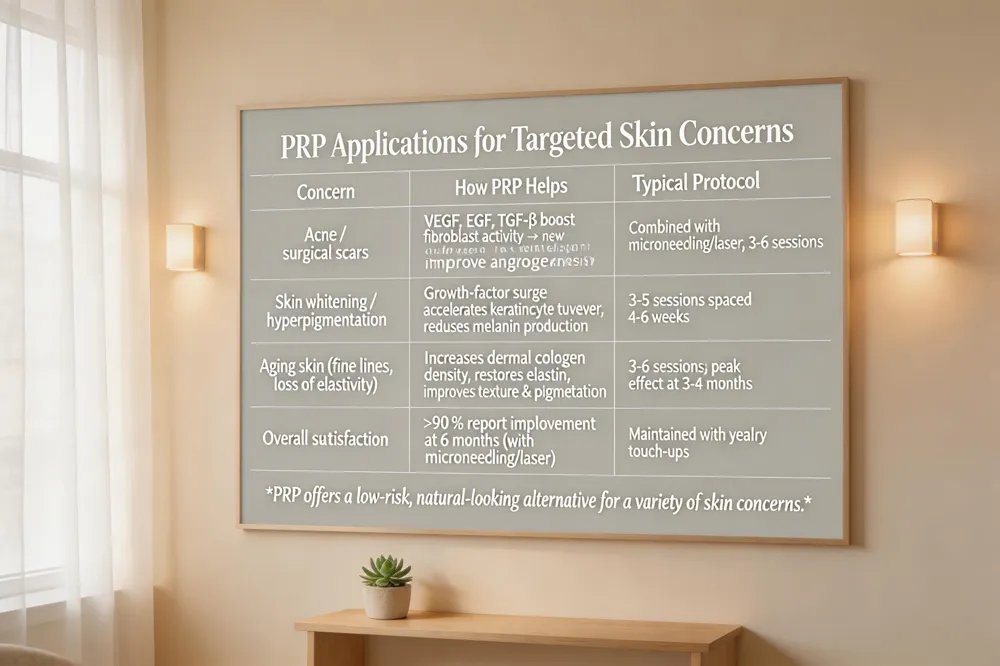 Platelet‑rich plasma (PRP) revitalizes skin scars by delivering a concentrated dose of autologous growth factors—VEGF, EGF, TGF‑β—to scarred tissue. These molecules jump‑start fibroblast activity, new collagen and elastin and improve angiogenesis, which smooths pitted areas and diminishes redness or darkening. When used after microneedling or fractional laser, PRP accelerates regeneration and restores an even tone.
For skin whitening, PRP’s growth‑factor surge promotes turnover of damaged keratinocytes, reduces melanin‑producing activity, and enhances collagen and elastin synthesis. The result is a brighter, more uniform complexion with only mild, transient redness or bruising; benefits accrue over a series of sessions and can last months when paired with proper skincare.
Older skin responds well to PRP: studies report increased dermal collagen density, reduced fine lines, and improved texture and pigmentation after 3‑6 sessions. Patient satisfaction is high—often >90 % at six months—especially when PRP is combined with microneedling or laser resurfacing, offering a natural, low‑risk option for rejuvenation.
Practical Considerations: Finding a Provider and Treatment Planning
Choosing a Provider & Planning Your PRP Regimen
| Consideration | Recommendation |
|---|---|
| Provider credentials | Board‑certified dermatologist or cosmetic surgeon with autologous blood product training |
| Clinic standards | Verify aseptic protocols, proper centrifuge calibration, and sterile handling |
| Typical regimen | 3‑4 sessions spaced 4‑6 weeks apart, followed by annual maintenance |
| Local example | Jana HealthCare (Brooklyn, NY) – offers PRP facial, microneedling, and complementary aesthetic services |
| Contact | Phone: (212) 555‑1234 – Online booking available |
| What to ask | Experience with PRP, number of sessions recommended, cost packages, post‑care instructions |
Proper provider selection and a clear treatment plan are key to safe, effective outcomes.
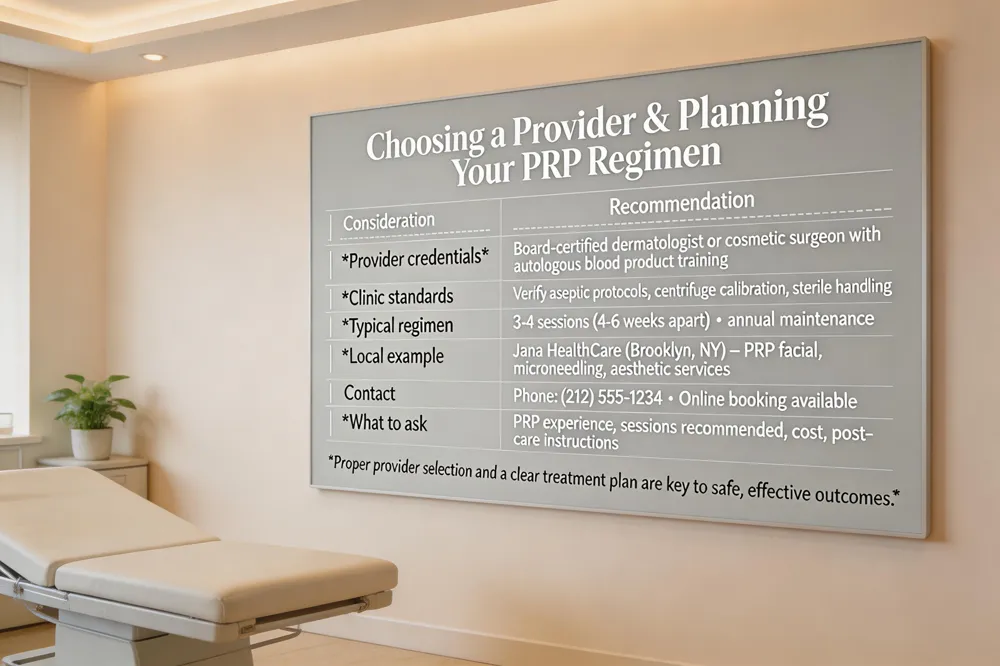 Choosing the right practitioner is essential for safe, effective PRP rejuvenation. Look for board‑certified dermatologists or cosmetic surgeons with specific training in autologous blood products, and verify that their clinic follows strict aseptic protocols. Local options such as Jana HealthCare in Brooklyn, NY, combine PRP with complementary aesthetic services for a personalized plan. A typical regimen includes 3‑4 sessions spaced 4‑6 weeks apart, followed by annual maintenance to preserve collagen gains.
PRP facial near me
If you’re looking for a PRP facial in Brooklyn, Jana HealthCare offers this cutting‑edge treatment at our multidisciplinary practice in Brooklyn, NY. A PRP facial uses your own platelet‑rich plasma to stimulate collagen production, tighten sagging skin, and improve texture with minimal downtime. Our board‑certified physicians and aesthetic specialists customize each session to your skin type and concerns, ensuring safe, natural‑looking results that can last up to a year. Conveniently located in the heart of Brooklyn, we combine PRP with other dermatology and wellness services for a comprehensive rejuvenation plan. Call (212) 555‑1234 or book online to schedule your consultation today.
How PRP revitalizes skin on face
Platelet‑rich plasma (PRP) is created by drawing a small amount of your blood, spinning it in a centrifuge to concentrate the platelets, and then injecting the platelet‑rich portion into the facial skin. The platelets release growth factors such as PDGF, TGF‑β, and VEGF, which stimulate fibroblasts to produce new collagen and elastin fibers, restoring the skin’s structural framework. This surge in collagen and elastin improves skin thickness, elasticity, and reduces the appearance of fine lines and wrinkles. PRP also promotes the formation of fresh skin cells and enhances micro‑circulation, giving the complexion a brighter, more even tone. When combined with a temporary hyaluronic‑acid filler, the treatment can instantly plump the skin while the growth factors work over weeks to achieve long‑term rejuvenation.
Can a dermatologist do PRP injections?
Yes—board‑certified dermatologists are qualified to perform platelet‑rich plasma (PRP) injections. Dermatologists receive extensive training in skin anatomy, wound healing and cosmetic procedures, which includes the preparation and precise placement of PRP for facial rejuvenation, scar improvement, and hair‑loss treatment. Because they specialize in both medical and aesthetic skin care, they can evaluate whether PRP is the most appropriate option for your specific concerns and adjust the protocol safely. In a multidisciplinary practice like Jana HealthCare, a dermatologist can integrate PRP with other therapies for a comprehensive, personalized plan. Choosing a board‑certified dermatologist ensures the procedure is performed with the highest standards of safety and efficacy.
How long does a PRP facelift last?
A PRP facelift typically delivers noticeable tightening and smoother skin that lasts approximately 6 to 12 months. Most patients achieve optimal results after a series of 1 to 3 treatments spaced out over a few weeks, allowing collagen production to build gradually. The rejuvenating effects continue to improve for several weeks after each session as the body’s natural healing processes take place. Individual longevity can vary—younger skin, good sun protection, and a healthy lifestyle tend to extend the outcome. To maintain a youthful appearance, many patients schedule a touch‑up PRP session once a year or as recommended by their practitioner at Jana HealthCare.
Integrating PRP into Your Skin‑Wellness Journey
A successful PRP regimen begins with a personalized plan that matches your skin type, age, and aesthetic goals. During the initial consultation, the clinician assesses factors such as baseline collagen density, facial texture, and any active skin conditions, then tailors the number of sessions (typically three‑to‑four injections spaced 4‑6 weeks apart) and the PRP preparation (leukocyte‑poor for rejuvenation, leukocyte‑rich for scar repair). Long‑term maintenance is essential: after the initial series, most patients schedule touch‑up treatments every 6‑12 months to sustain collagen remodeling and keep texture smooth. Finally, a holistic approach integrates PRP with lifestyle habits—adequate hydration, balanced nutrition rich in antioxidants, sunscreen use, and gentle skincare—to amplify growth‑factor effects and protect against UV‑induced damage. This combined strategy maximizes natural, lasting skin vitality.