Welcome to Your First Botox Experience
A first‑time Botox session is designed to soften dynamic facial lines—such as crow’s feet, forehead furrows, and frown lines—by temporarily relaxing the underlying muscles, giving you a refreshed, natural look without “freezing” expressions. From the moment you arrive, a qualified Brooklyn practitioner (often a board‑certified dermatologist, plastic surgeon, or experienced aesthetic nurse at a reputable clinic like Jana HealthCare) will review your medical history, discuss aesthetic goals, and map precise injection sites. You’ll clean your skin, possibly apply a topical numbing cream, and receive 10‑15 minutes of fine‑needle injections (typically 6‑12 units per eye for crow’s feet). After staying upright for 4‑6 hours and avoiding rubbing, intense exercise, or alcohol for 24‑48 hours, you’ll notice subtle changes within 2‑3 days, with full smoothing by 10‑14 days lasting 3‑4 months. Choosing an experienced, fully licensed injector in Brooklyn ensures safe technique, minimal bruising, and optimal, personalized results.
Pre‑Appointment Preparation and Eligibility
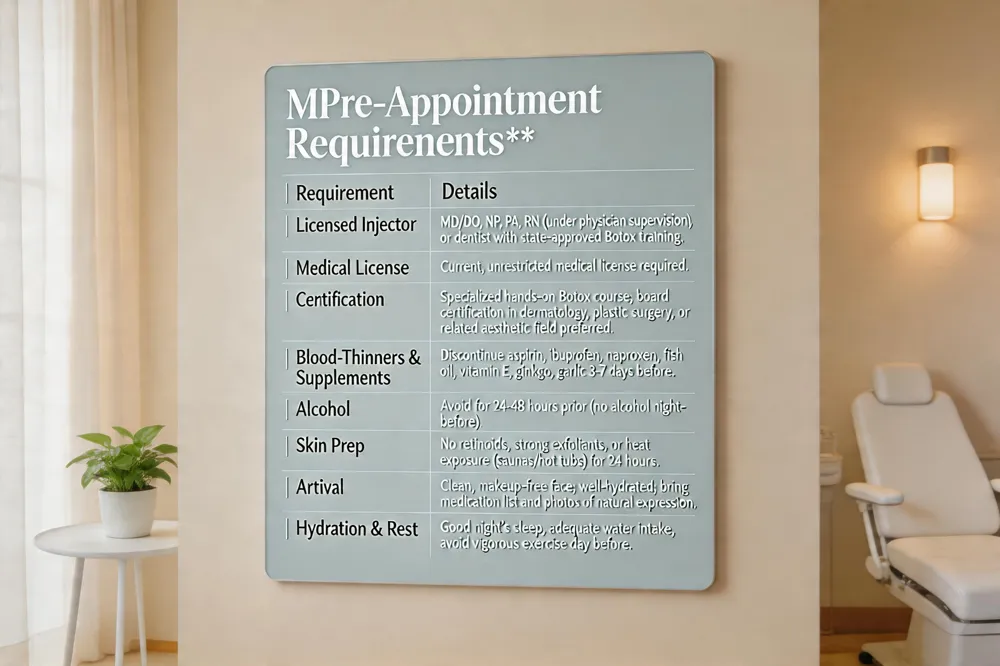
MPre‑Appointment Requirements**
| Requirement | Details |
|---|---|
| Licensed Injector | MD/DO, NP, PA, RN (under physician supervision), or dentist with state‑approved Botox training. |
| Medical License | Current, unrestricted medical license required. |
| Certification | Specialized hands‑on Botox course; board certification in dermatology, plastic surgery, or related aesthetic field preferred. |
| Blood‑Thinners & Supplements | Discontinue aspirin, ibuprofen, naproxen, fish oil, vitamin E, ginkgo, garlic 3‑7 days before. |
| Alcohol | Avoid for 24‑48 hours prior (no alcohol night‑before). |
| Skin Prep | No retinoids, strong exfoliants, or heat exposure (saunas/hot tubs) for 24 hours. |
| Arrival | Clean, makeup‑free face; well‑hydrated; bring medication list and photos of natural expression. |
| Hydration & Rest | Good night’s sleep, adequate water intake, avoid vigorous exercise day before. |
 In New York State, only licensed medical professionals may administer Botox. This includes physicians (MDs/DOs), nurse practitioners (NPs), physician assistants (PAs) and registered nurses (RNs) who work under a physician’s direct supervision. Dentists with a valid dental license and state‑approved Botox training are also authorized, while pharmacists are not permitted to inject. All injectors must hold a current medical license, complete a specialized, hands‑on Botox certification course, and ideally have board certification in dermatology, plastic surgery, or a related aesthetic specialty.
Night‑before and day‑of preparation – Skip alcohol, which can thin the blood and increase bruising. Discontinue blood‑thinners (aspirin, ibuprofen, naproxen) and supplements (fish oil, vitamin E, ginkgo, garlic) at least 3–7 days prior. Avoid retinoids, strong exfoliants, and excessive heat (saunas, hot tubs) for 24 hours. Arrive with a clean, makeup‑free face, well‑hydrated and having reviewed all medications and medical history with your provider.
Pre‑appointment checklist – 1) Stop blood‑thinners and bruising‑enhancing supplements 3–7 days before. 2) No alcohol for 24–48 hours. 3) Hydrate, get a good night’s sleep, and avoid vigorous exercise or heat exposure. 4) Bring a list of current meds, supplements, and any photos of your natural facial expression. Following these steps helps minimize bruising, ensures safe injection technique, and sets the stage for optimal, natural‑looking results.
The Consultation and Treatment Planning
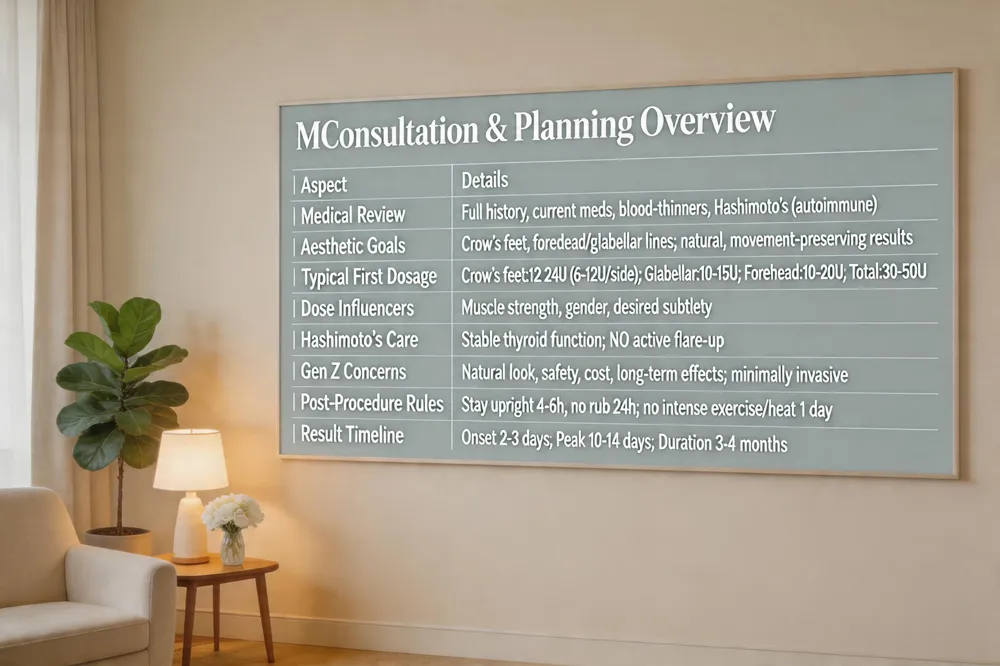
MConsultation & Planning Overview**
| Aspect | Details |
|---|---|
| Medical Review | Full history, current meds, blood‑thinners, autoimmune conditions (e.g., Hashimoto’s). |
| Aesthetic Goals | Crow’s feet, forehead lines, glabellar lines; focus on natural, movement‑preserving results. |
| Dosage (Typical First‑Time) | Crow’s feet: 12‑24 U total (6‑12 U/side); Glabellar: 10‑15 U; Forehead: 10‑20 U; Overall: 30‑50 U. |
| Factors Influencing Dose | Muscle strength, gender, desired subtlety. |
| Hashimoto’s Considerations | Verify stable thyroid function; no active flare‑up. |
| Gen Z Concerns | Emphasis on natural look, safety, cost, long‑term effects; education on minimally invasive nature. |
| Post‑Procedure Instructions | Stay upright 4‑6 h, avoid rubbing/massaging 24 h, no intense exercise/heat for 1 day. |
| Result Timeline | Onset 2‑3 days, peak 10‑14 days, duration 3‑4 months. |
 A thorough, face‑to‑face medical consultation is the cornerstone of a safe and effective first‑time Botox experience. During this visit the practitioner reviews your full medical history, current medications (especially blood‑thinners or supplements), and any autoimmune conditions such as Hashimoto’s disease to confirm stability and rule out contraindications. You will also discuss your aesthetic goals—whether you want to soften crow’s feet, forehead lines, or frown lines—and the provider will map the precise injection sites.
For first‑time patients the dosage is usually conservative: about 12–24 units total for crow’s feet (6–12 units per side), 10–15 units for the glabellar (frown‑line) area, and 10–20 units for forehead lines, resulting in a typical total of 30–50 units across the upper face. The exact number of units depends on muscle strength, gender, and the desired natural look.
Patients with Hashimoto’s disease can generally receive Botox, but the clinician will verify that thyroid function is well‑controlled and that no active flare‑up is present. This precaution helps minimize bruising or unexpected inflammation.
Gen Z patients often hesitate because they value a natural, movement‑preserving appearance and prefer preventive skin‑health strategies over neurotoxin use. Concerns about safety, cost, and long‑term effects also play a role, so educators emphasize the minimally invasive nature of Botox, its short downtime, and the ability to achieve subtle, refreshed results when administered by a qualified professional.
Post‑procedure, you’ll be advised to stay upright for 4–6 hours, avoid rubbing or massaging the treated area for at least 24 hours, and postpone intense exercise or heat exposure for a day. Results typically emerge within 2–3 days, peak at 10–14 days, and last 3–4 months.
The Injection Procedure Step‑by‑Step
MStep‑by‑Step Injection Process**
| Step | Description |
|---|---|
| 1. Consultation | Review health history, aesthetic goals, eligibility. |
| 2. Skin Preparation | Cleanse area; optional topical numbing cream or ice pack (15‑20 min). |
| 3. Mapping | Tiny skin marks to identify target muscles (forehead, glabella, crow’s feet). |
| 4. Injection | 30‑32‑gauge micro‑needle; 0.5‑0.1 mL per site; micro‑droplet technique. |
| 5. Post‑Injection Care | Stay upright ≥4 h ("4‑hour rule"), avoid rubbing, no strenuous activity/sauna for 24 h. |
| 6. Immediate After‑Care | Gentle pressure on any pinpoint bruising; brief observation before discharge. |
| 7. Results | Initial softening 2‑3 days; full effect by week 2; lasts 3‑4 months. |
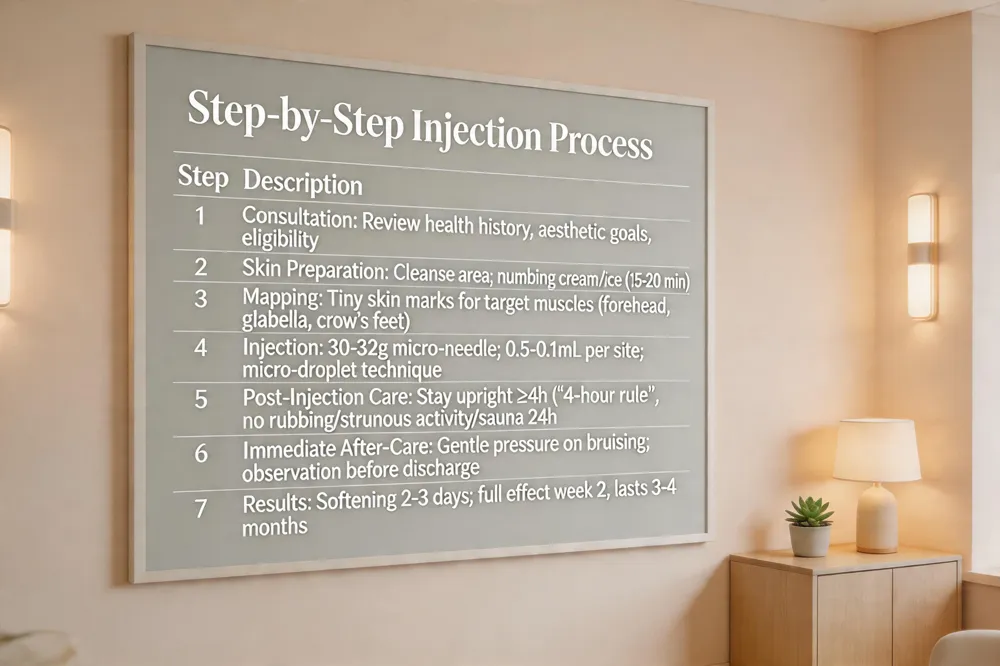 A first‑time Botox visit always begins with a thorough medical consultation: the clinician reviews your health history, discusses your aesthetic goals, and confirms that you are a suitable candidate. The treatment area is then cleansed, and the injector may draw tiny marks on the skin to map the precise muscles that cause your wrinkles. For most patients a topical numbing cream or a brief ice pack is applied 15‑20 minutes before the injection to ease any needle sensitivity.
Using a 30‑32‑gauge micro‑needle, the practitioner places Botox in micro‑droplets—typically 0.5‑0.1 mL per site—directly into the targeted muscle layers. For forehead lines the toxin is injected into the superficial frontalis, about 2 cm above the brows, avoiding the nearby corrugator and orbicularis oculi muscles. This blocks acetylcholine release, preventing the muscle from contracting and smoothing horizontal lines while preserving natural brow movement.
After the injections, patients are advised to stay upright for at least four hours (the "4‑hour rule"), refrain from rubbing or massaging the sites, and avoid strenuous exercise, saunas, or lying flat. Immediate post‑care includes gentle pressure to any pinpoint bruising and a brief observation period before you can resume normal activities. Initial softening of wrinkles is often seen within 2‑3 days, with full effect by week 2, lasting ‑4 months.
Aftercare, Expected Results and Longevity
MAfter‑Care & Result Timeline**
| Timeline | Expected Outcome / After‑Care |
|---|---|
| 0‑4 h | Remain upright; avoid intense exercise, facial massage, lying flat. |
| 0‑24 h | Possible mild redness, tenderness, brief headache, tiny bruise; resume normal activities. |
| 2‑3 days | Subtle softening of wrinkles begins. |
| 7‑10 days | Full effect typically evident; optimal smoothness. |
| 14‑30 days | Peak result; assess satisfaction. |
| 3‑4 months | Duration of effect; schedule maintenance if desired. |
| Maintenance | Appointments every 3‑4 months; repeat sessions may extend longevity. |
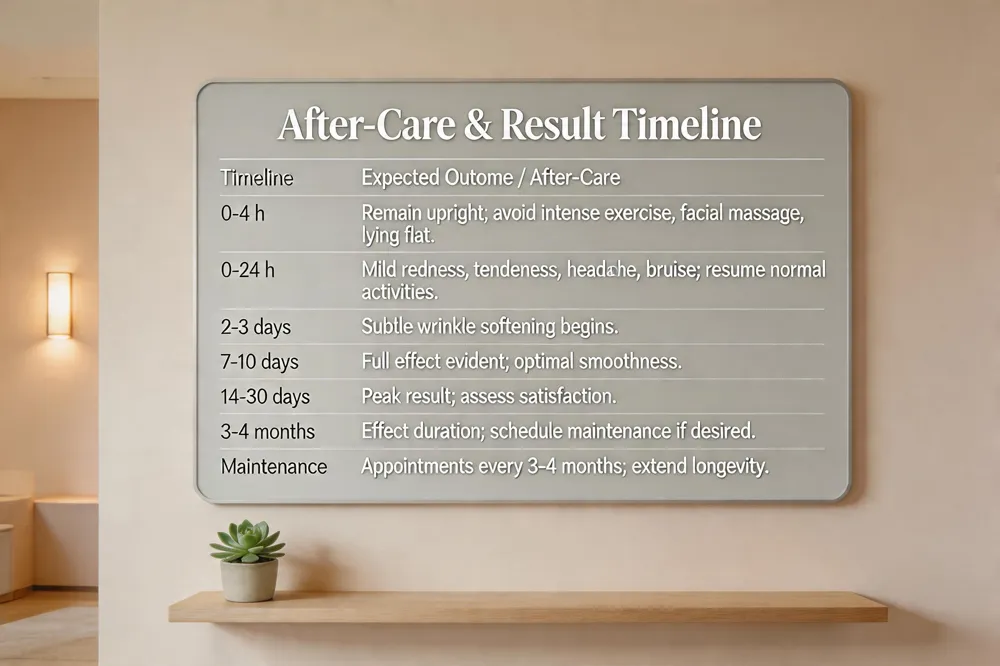 Following your first Botox appointment, most patients notice only mild redness, slight tenderness, a brief headache, or a small bruise at the injection sites—these sensations usually fade within a few days. You can resume normal activities right away, but for the first four hours avoid intense exercise, facial massages, and lying flat to keep the toxin where it belongs. The smoothing effect isn’t immediate; subtle softening of wrinkles typically appears within 2‑3 days, with the full result becoming clear by the end of the first week or up to two weeks. After a first‑time treatment, the full effect is usually evident around 7‑10 days, and the results generally last 3‑4 months. Some first‑timers may see a slightly shorter duration, but repeat sessions often extend longevity as facial muscles become accustomed to the toxin. Maintenance appointments every 3‑4 months are common to keep the desired smoothness. For a qualified injector near Brooklyn, NY, consider Jana HealthCare— a multidisciplinary practice‑‑ board‑certified physicians and nurse practitioners trained in cosmetic dermatology. Their clinic follows strict safety protocols, personalizes dosage, and provides thorough after‑care guidance to ensure natural, lasting results.
Safety, Side Effects and Emerging Trends
MSafety & Emerging Trends**
| Category | Information |
|---|---|
| Mechanism | Temporarily blocks acetylcholine at neuromuscular junction → muscle relaxation. |
| Common Mild Side‑Effects | Localized redness, swelling, bruising, brief headache; resolve 24‑48 h. |
| Rare Complications | Temporary eyelid/brow ptosis, asymmetry (<1 %); usually improve within weeks. |
| Technique Advancement | Micro‑droplet dosing (0.5‑0.1 mL/site) with 30‑31‑gauge needles reduces diffusion & bruising. |
| Emerging Tech | Finer micro‑needles, AI‑guided muscle mapping, longer‑lasting formulations under investigation. |
| Safety Emphasis | Strict adherence to licensure, certification, and patient‑specific dosing ensures natural results. |
 Botox works by temporarily blocking acetylcholine release at the neuromuscular junction, which relaxes the targeted facial muscles (the orbicularis oculi around the eyes, frontalis on the forehead, and corrugator/procerus in the glabella). This neuromodulation smooths dynamic wrinkles while preserving natural expression when injected by a trained professional.
Typical mild side‑effects are limited to localized redness, swelling, bruising, or a brief headache and usually resolve within 24‑48 hours. Rare complications can include temporary eyelid or brow drooping (ptosis) and asymmetry, affecting less than 1 % of patients and generally improving within weeks.
To maximize safety and natural results, many clinicians now employ a micro‑droplet technique—injecting 0.5‑0.1 mL of Botox per site with a 30‑31‑gauge needle. This precise dosing minimizes diffusion, reduces bruising, and helps avoid the “frozen” look. Emerging advances point toward even finer micro‑needles, AI‑guided mapping of muscle activity, and longer‑lasting formulations that could extend the 3‑4‑month effect while maintaining the low‑risk profile that makes Botox a cornerstone of modern aesthetic care.
Your First Botox Journey Starts Here
Before you step into the treatment chair, pause to absorb the behind‑the‑scenes essentials: stop blood‑thinners (aspirin, ibuprofen, fish oil, vitamin E, ginkgo, garlic) 3–7 days, skip alcohol for 24–48 hours, and arrive with a clean, makeup‑free face. The 10‑15‑minute injection uses a fine 30‑31 gauge needle, often with a topical numbing cream, to place 6‑12 units per eye for crow’s feet. Afterward stay upright for 4‑6 hours, avoid rubbing or vigorous exercise for at least 24 hours, and expect subtle redness that fades within minutes.
Choosing a qualified Brooklyn provider matters. Look for a board‑certified dermatologist, plastic surgeon, or nurse practitioner with documented aesthetic training (GMC, BCAM, BACN or AAAMS). Verify they prescription Botox‑onlysingle insurance sterile so, and before‑and‑after photos that reflect natural, “non‑frozen” results.
Ready to begin? Call the clinic, request a pre‑procedure consultation, and bring a list of medications, supplement use, and photos of your natural smile. The team will map your facial muscles, tailor the dose, and schedule your first appointment—setting you on a path to smoother lines and confident, holistic wellness.