Why the Medical Exam Matters
U.S. immigration law treats health as a public‑interest issue. Under INA Sections 212(a) and 221(d) a visa or green‑card applicant must be free of certain communicable diseases and meet vaccination standards before admission is granted. The civil surgeon’s report—Form I‑693—captures the physical exam, TB and syphilis screens, mental‑health review, and vaccination record, and it is sealed for USCIS. Because the form must accompany Form I‑485 (or be presented at a consular interview), any missing test, incomplete vaccination list, or unsigned envelope can trigger a denial, delay, or a Request for Evidence. In short, medical eligibility is a gatekeeper that directly determines whether an immigration application proceeds or stalls.
Preparing for Your Appointment
Key Documents to Bring
| Document | Why It’s Needed |
|---|---|
| Original passport (or government‑issued photo ID) | Verifies identity and links exam to case |
| Appointment letter / visa interview notice | Shows USCIS‑approved exam requirement |
| Recent passport‑size photos (2‑4) | Required for Form I‑693 envelope |
| Vaccination record or immunization card | Proves CDC‑required vaccines; missing shots may be given on‑site |
| Medical‑history questionnaire (printed) | Helps surgeon assess chronic conditions and meds |
| Treatment certificates & chest X‑ray (if TB/other disease) | Documents prior treatment for communicable diseases |
| Birth certificate & pediatric vaccine record (children <15) | Required for minors; chest X‑ray not needed |
| Prenatal care docs (pregnant applicants) | Needed for chest X‑ray consent and health assessment |
| COVID‑19 vaccination certificate | Additional proof for recent travel/health requirements |
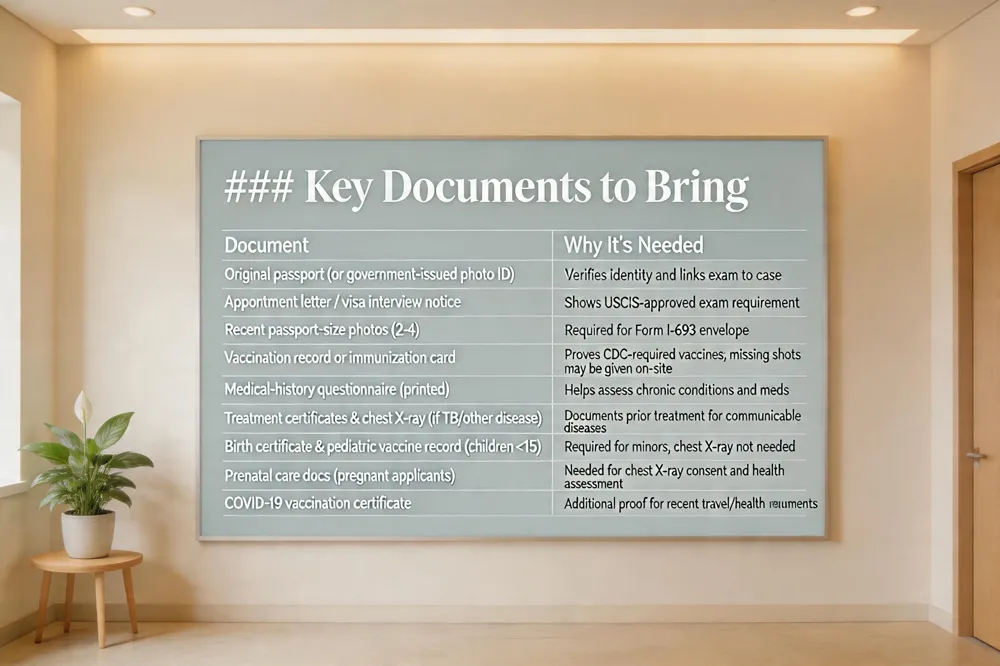 When you walk into a civil surgeon’s office for your immigration medical exam, the first thing the clinician will check is a valid government‑issued photo ID—usually a passport or driver’s license—and the exact immigration paperwork listed on your appointment letter (e.g., the visa interview notice or I‑485 receipt). Bring the original passport, a copy of the appointment letter, and a recent passport‑size photo; these items confirm your identity and link the exam to your case.
Vaccination records are essential. Carry any official immunization cards or, if you lack them, be prepared for the physician to run antibody titers or administer missing shots on the spot. For those who have been treated for tuberculosis, syphilis, or other communicable diseases, bring the physician‑signed treatment certificates and any chest X‑ray films.
Complete the medical‑history questionnaire ahead of time and bring a printed list of all current medications, supplements, and dosages. This helps the surgeon assess chronic conditions and any potential drug interactions.
Children under 15 generally do not need a chest X‑ray or syphilis blood test, but you should still bring a birth certificate and any pediatric vaccination records. Pregnant applicants must consent to a chest X‑ray (with double‑layer lead shielding) and should carry prenatal care documentation.
What documents are required for a visa medical test? You need your original passport (plus three color copies), four passport‑size photos, the immigration‑medical‑examination letter, printed medical records, vaccination cards, and a COVID‑19 vaccination certificate.
Documents needed for immigration medical exam near Fort Worth, TX Bring a government‑issued photo ID, your passport, two passport‑size photos, vaccination records (or blood‑test proof), prior medical records, and the completed medical‑history questionnaire. The civil surgeon will handle the chest X‑ray and blood tests and give you a sealed Form I‑693 for USCIS.
What documents is ICE asking for? ICE may request a passport or driver’s license, proof of immigration status (green card, visa, I‑94), and any legal‑presence documents such as a USCIS approval notice or asylum receipt. If you lack these, you can remain silent and request legal counsel.
What Happens During the Exam
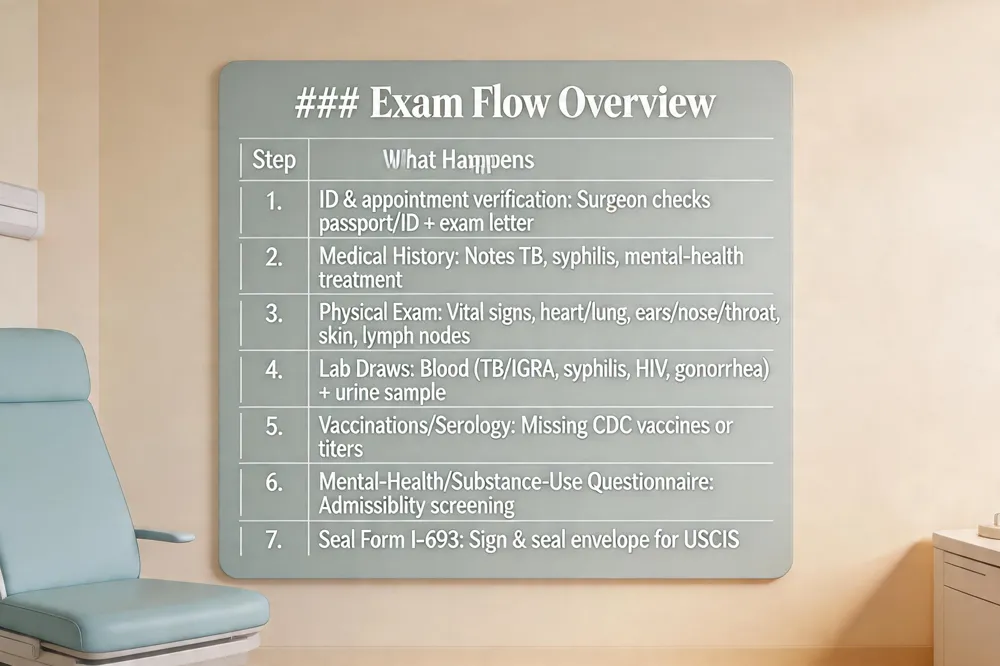
Exam Flow Overview
| Step | What Happens |
|---|---|
| 1. ID & appointment verification | Surgeon checks passport/ID and exam letter |
| 2. Review of medical history & vaccinations | Surgeon notes prior TB, syphilis, mental‑health treatment, etc. |
| 3. Physical examination | Vital signs, heart/lung auscultation, eyes, ears, nose, throat, skin, lymph nodes |
| 4. Laboratory draws | Blood for TB (IGRA), syphilis, HIV, gonorrhea; urine sample |
| 5. Vaccinations / serology | Administer missing CDC vaccines or provide titers |
| 6. Mental‑health & substance‑use questionnaire | Screens for conditions affecting admissibility |
| 7. Seal Form I‑693 | Surgeon signs & seals envelope for USCIS submission |
 I-693 medical exam what to expect
When you arrive, a USCIS‑approved civil surgeon (or a panel physician abroad) will first verify your passport (or other photo ID) and the appointment letter. The doctor then reviews your medical and immunization history, noting any prior tuberculosis, syphilis, or mental‑health treatment. A comprehensive physical follows: vital signs, heart and lung auscultation, inspection of eyes, ears, nose, throat, skin, and lymph nodes. Blood is drawn and a urine sample is collected for laboratory testing that screens for tuberculosis (IGRA or chest X‑ray if indicated), syphilis, HIV, and gonorrhea. Any missing vaccines from the CDC‑required list (MMR, Tdap, varicella, hepatitis A/B, influenza, etc.) are administered on‑site or documented with a blood‑titer result. The clinician also conducts a brief mental‑health and substance‑use questionnaire to identify disorders that could affect admissibility. After all required tests are completed and any follow‑up referrals are made, the surgeon signs and seals Form I‑693, which you will submit with your green‑card application.
I-693 medical exam what to expect
When you arrive, a USCIS‑approved civil surgeon (or a panel physician abroad) will first verify your passport (or other photo ID) and the appointment letter. The doctor then reviews your medical and immunization history, noting any prior tuberculosis, syphilis, or mental‑health treatment. A comprehensive physical follows: vital signs, heart and lung auscultation, inspection of eyes, ears, nose, throat, skin, and lymph nodes. Blood is drawn and a urine sample is collected for laboratory testing that screens for tuberculosis (IGRA or chest X‑ray if indicated), syphilis, HIV, and gonorrhea. Any missing vaccines from the CDC‑required list (MMR, Tdap, varicella, hepatitis A/B, influenza, etc.) are administered on‑site or documented with a blood‑titer result. The clinician also conducts a brief mental‑health and substance‑use questionnaire to identify disorders that could affect admissibility. After all required tests are completed and any follow‑up referrals are made, the surgeon signs and seals Form I‑693, which you will submit with your green‑card application.
Immigration medical exam: what do they check The exam checks for communicable diseases (TB, syphilis, gonorrhea, HIV), verifies that you have up‑to‑date vaccinations, and evaluates mental‑health status. Abnormal findings may trigger additional testing or treatment before the Form I‑693 can be finalized.
Green card medical exam what to expect You will present a valid ID and appointment notice, undergo the physical and laboratory assessments described above, receive any required immunizations, and leave with a sealed Form I‑693 envelope ready for filing.
Validity, Timing, and What You Need to Know About Form I‑693
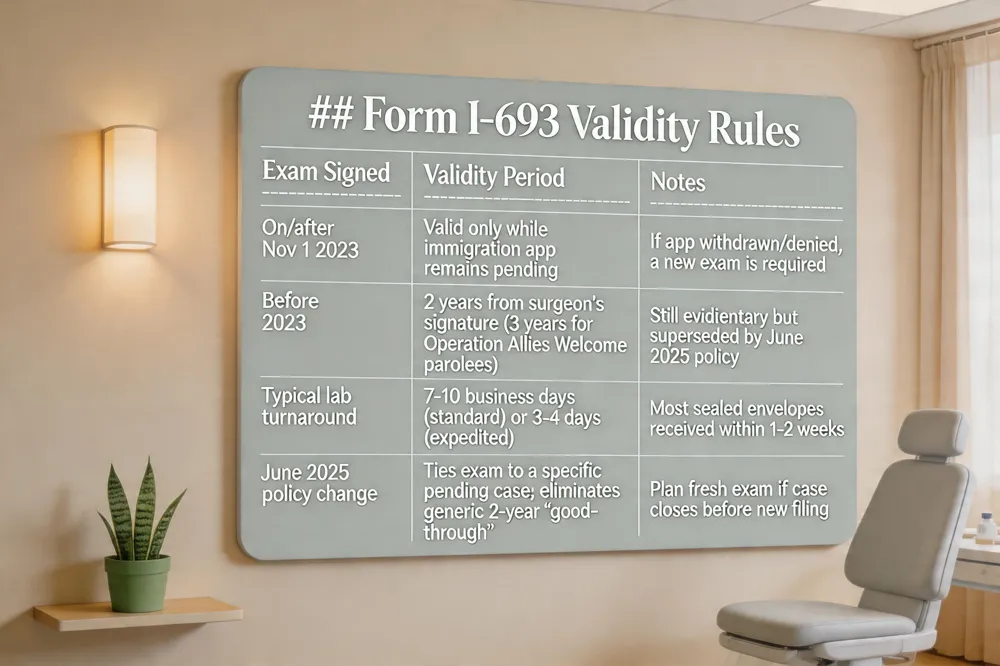
Form I‑693 Validity Rules
| Exam Signed | Validity Period | Notes |
|---|---|---|
| On/after Nov 1 2023 | Valid only while the associated immigration application remains pending | If application is withdrawn/denied, a new exam is required |
| Before Nov 1 2023 | 2 years from surgeon’s signature (3 years for Operation Allies Welcome parolees) | Still evidentiary but superseded by June 2025 policy |
| Typical lab turnaround | 7‑10 business days (standard) or 3‑4 days (expedited) | Most sealed envelopes received within 1‑2 weeks |
| June 2025 policy change | Ties exam to a specific pending case; eliminates generic 2‑year “good‑through” | Plan fresh exam if case closes before new filing |
 How long does an immigration medical exam stay valid?
A Form I‑693 signed on or after Nov 1 2023 is valid only while the immigration application it accompanies remains pending. If that application is withdrawn, denied, or otherwise closed, a new exam is required. Exams signed before Nov 1 2023 retain evidentiary value for two years from the civil surgeon’s signature (three years for certain parolee cases such as Operation Allies Welcome). The earlier “indefinite” validity announced in April 2024 was superseded by the June 2025 policy that ties the exam to a specific case.
How long is the USCIS medical exam good for?
For post‑Nov 1 2023 exams, validity is case‑specific with no fixed calendar expiration. Pre‑Nov 1 2023 exams are good for two years (or three years for Operation Allies Welcome parolees). Once you file a new petition, you must submit a current, sealed Form I‑693 that matches that case.
Typical turnaround from exam to sealed envelope
Standard lab processing takes 7‑10 business days; expedited testing can shrink this to 3‑4 days. Most applicants receive the sealed Form I‑693 within 1‑2 weeks of the first visit, with on‑site clinics sometimes delivering results in 3‑7 days.
Effect of the June 2025 USCIS policy change
The June 2025 update limits Form I‑693’s usefulness to the pending application it was filed with, eliminating the prior practice of using a two‑year “good‑through” period for new filings. Applicants must plan for a fresh medical exam if a prior case is closed before filing a new one.
Finding a Surgeon, Costs, and Practical Tips
Cost & Practical Tips
| Item | Typical Range | Comments |
|---|---|---|
| Basic exam (physical, TB & syphilis tests, standard vaccines) | $200‑$500 (average $250‑$300) | Most clinics charge within this band |
| Additional vaccines / chest X‑ray | $0‑$200 extra | Depends on missing immunizations |
| Bundled packages | $350‑$400 (incl. all services) | May be cost‑effective for full I‑693 |
| Payment method | Credit/debit card, cash, money order | Most surgeons do not accept health‑insurance for immigration exam |
| Deposit / admin fee | $50‑$100 (often required up‑front) | Ask clinic beforehand |
| Example Brooklyn surgeons | Jana HealthCare, Doral Health & Wellness, Greenleaf Medical Associates | Authorized civil surgeons handling full I‑693 process |
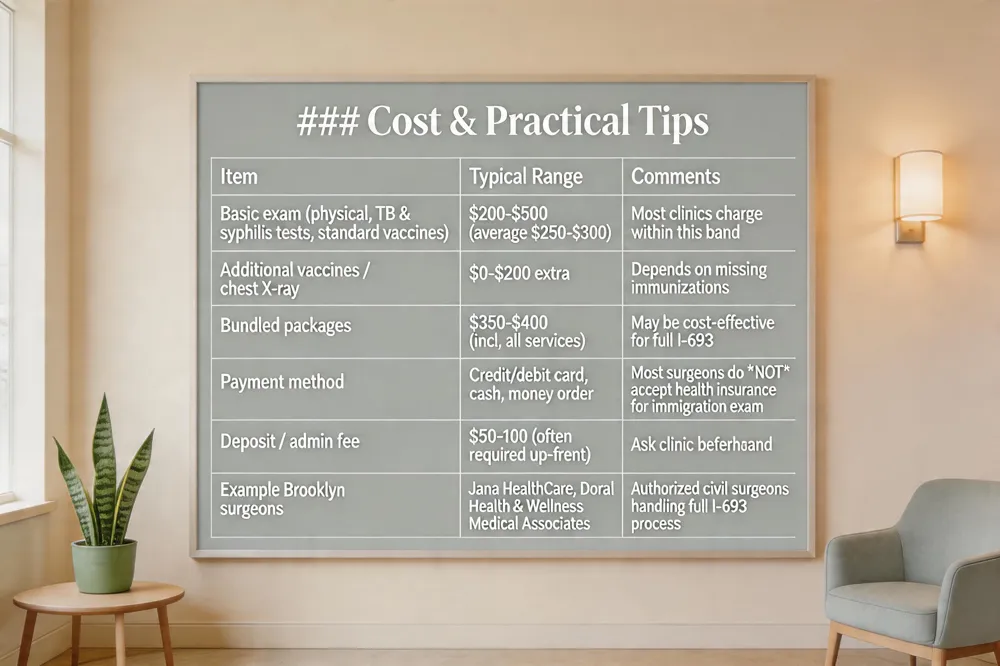 Typical fees range from $200 to $500 for the basic exam, with most clinics charging $250‑$300. This amount usually covers the physical exam, TB and syphilis testing, and a standard set of vaccinations. Additional vaccines (MMR, Tdap, Hepatitis B, etc.) and a chest X‑ray can add $0‑$200. Some providers bundle everything for $350‑$400, while others itemize each service.
Insurance and payment: Most civil surgeons do not accept health‑insurance benefits for the immigration exam, so expect out‑of‑pocket costs. Bring a credit/debit card, cash, or a money order, and ask ahead about any deposit or administrative fee ($50‑$100).
Brooklyn options: Jana HealthCare (Brooklyn, NY) and nearby clinics such as Doral Health & Wellness and Greenleaf Medical Associates are authorized civil surgeons that handle the full I‑693 process, administer missing vaccines, and provide sealed envelopes for USCIS.
FAQs – “Immigration medical exam near me?” Use the USCIS tool or search “USCIS civil surgeon Brooklyn.” “USCIS medical exam cost?” Expect $200‑$500, with $250‑$300 common for the exam itself. “How much do doctors charge for I‑693?” Typical total $250‑$650, including a $50‑$100 administrative fee. “Immigration medical exam doctor list?” The USCIS “Find a Doctor” page gives a complete local list.
Common Pitfalls, FAQs, and Practical Advice
Frequently Missed Issues
| Pitfall | Potential Impact | Recommendation |
|---|---|---|
| Submitting I‑485 without sealed Form I‑693 | USCIS rejection of adjustment‑of‑status filing | Ensure sealed envelope is included at time of filing |
| Using non‑civil‑surgeon physician or outdated I‑693 edition | Form may be deemed invalid | Verify surgeon is USCIS‑designated and using current edition |
| Missing signatures, dates, or vaccination records | Exam failure or request for re‑exam | Double‑check all sections before signing |
| Undisclosed communicable disease or mental‑health issue | Inadmissibility or additional treatment required | Provide complete medical history; seek treatment if needed |
| Fasting before exam | Unnecessary discomfort | No fasting required; eat a light, balanced meal and stay hydrated |
| Ignoring ICE document requests without counsel | Potential legal complications | Invoke right to counsel and provide only required ID and immigration proof |
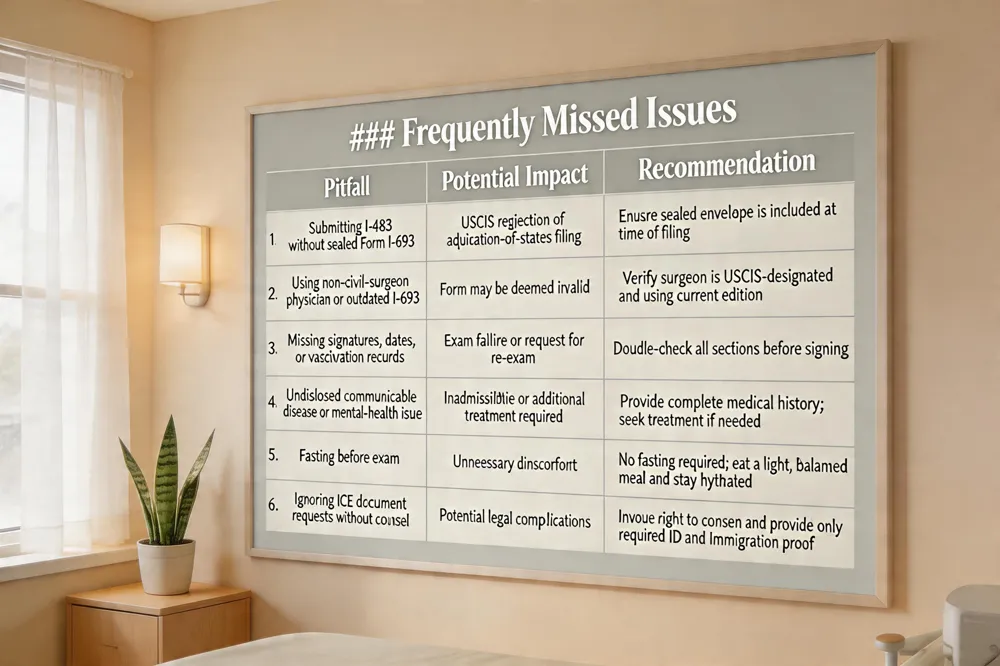 Submitting Form I‑485 without a medical exam – USCIS will reject an adjustment‑of‑status filing that lacks a sealed Form I‑693. The medical form must be signed by a USCIS‑designated civil surgeon and submitted at the same time as the I‑485. Only a few narrow categories (refugees, derivative asylees, certain K‑visa holders with an approved overseas exam) may file a “partial” Form I‑693, but even they must include the sealed envelope.
Reasons for exam failure – Failure can stem from using a non‑civil‑surgeon physician, an outdated I‑693 edition, missing signatures or dates, or incomplete vaccination records. Positive results for communicable diseases (active TB, syphilis, etc.), undisclosed substance‑abuse or dangerous mental‑health conditions, or omitted lab tests also render the exam inadmissible.
Pre‑exam nutrition and fasting – No fasting is required. Eat a light, balanced meal (e.g., fruit, oatmeal, a boiled egg) and stay hydrated. Avoid heavy, greasy, or sugary foods that could cause discomfort during the 30‑45‑minute physical and lab draws.
Understanding ICE document requests – ICE may ask for government‑issued ID, immigration status proof (green card, visa, I‑94), and any approval notices. Carry at least one official immigration document; if unavailable, invoke your right to counsel before responding.
Quick answers to frequent questions – (1) Can you file I‑485 without a medical exam? No. (2) What can cause exam failure? Non‑designated doctors, form errors, missing vaccines, or treatable infectious diseases. (3) Should you fast? No, a modest meal is fine. (4) What does ICE ask for? ID and proof of legal presence. (5) Why are vaccination records critical? They verify CDC‑required immunizations; missing records must be remedied on‑site or via serology.
Next Steps and Final Checklist
Schedule your immigration medical exam early—most clinics have a two‑week wait, and early booking allows time for any required labs or vaccinations. Bring a valid government‑issued photo ID, passport or driver’s license, the appointment letter, and complete vaccination records (or a list of missing shots). Confirm the exam fee and accepted payment methods (cash, card, or insurance for vaccines). After the civil surgeon seals Form I‑693, keep the envelope sealed and stored safely until you submit it with your I‑485.