Introduction
Laser hair removal is a non‑invasive, FDA‑cleared procedure that uses concentrated light energy to target melanin in the hair follicle. The laser’s selective photothermolysis heats and damages the follicle, inhibiting future growth while sparing surrounding skin. Because hair grows in cycles, multiple sessions—typically six to eight—are needed to catch follicles in the active (anagen) phase, each treatment making regrown hairs finer and lighter.
Achieving smooth, silky skin matters for more than aesthetics. Eliminating daily shaving or frequent waxing reduces razor burn, ingrown hairs, and skin irritation, leading to a more comfortable, confident appearance. The cumulative effect is a softer, more uniform texture that often improves overall skin tone and reduces hyperpigmentation caused by repeated friction. For patients seeking lasting hair‑free results with minimal downtime, laser hair removal offers a personalized, medically sound solution that aligns with holistic wellness and long‑term skin health.
How Laser Hair Removal Works
 Laser hair removal relies on the principle of selective photothermolysis, where a concentrated beam of light is absorbed by melanin—the pigment inside the hair shaft and follicle. The absorbed light energy converts to heat, damaging the follicle’s stem cells while sparing surrounding skin. This targeted thermal injury disrupts the hair growth cycle, leading to long‑lasting reduction after multiple sessions that catch follicles in their active (anagen) phase. Modern laser platforms—including diode (800‑810 nm), alexandrite (755 nm), and Nd:YAG (1064 nm)—are calibrated to match different Fitzpatrick skin types, allowing safe treatment of both light and darker complexions.
How laser hair removal works on face: Laser hair removal on the face uses a focused beam of light that is selectively absorbed by the melanin in each hair shaft. The light energy converts to heat, which damages the hair follicle’s stem cells without harming surrounding skin. This damage temporarily disables the follicle’s ability to produce new hair, leading to a long‑lasting reduction in facial hair growth. Because hair growth occurs in cycles, several treatment sessions are required to target follicles in different phases. The procedure is most effective for individuals with a clear contrast between dark hair and lighter skin, though modern lasers can safely treat a wide range of skin types.
Clinical Benefits Beyond Hair Reduction
 Laser hair removal does far more than eliminate daily shaving or waxing.
Ingrown hair and razor‑burn reduction – By destroying the follicle root, the laser prevents hairs from re‑growing incorrectly, slashing the incidence of razor bumps and painful ingrown hairs that common with traditional methods. Patients often notice smoother, bump‑free skin within a few weeks of treatment.
Improved skin texture and tone – The precise, melanin‑targeted energy spares surrounding skin, resulting in minimal redness and swelling. Over a full series of 6‑8 sessions, the skin’s surface becomes softer and more uniform; reduced friction from shaving or waxing also lessens hyperpigmentation and “strawberry‑leg” appearance. Some studies even suggest a modest boost in collagen production, enhancing elasticity and overall radiance.
Long‑term cost and time savings – While the upfront investment averages $389 per session in the U.S., the cumulative expense of razors, shaving creams, waxing appointments, and lost minutes each week quickly eclipses that price. After completing the recommended protocol, most patients need only occasional maintenance, translating to years of low‑maintenance smoothness.
Permanent‑looking smoothness – Each successful pulse removes a portion of active follicles; hair that does regrow is finer and lighter. Clinical data show 70‑90 % hair reduction after the full course, delivering a near‑permanent, hair‑free complexion that feels and looks natural.
In short, laser hair removal offers a safe, predictable, and skin‑friendly solution that delivers lasting aesthetic and wellness benefits well beyond simple hair reduction.
Safety, Side Effects, and Contraindications
 Laser hair removal is a non‑invasive, FDA‑cleared procedure that, most low when performed by a trained clinician. Common temporary reactions include mild redness, swelling, and a warm‑pinprick sensation that typically resolve within a few hours to a day. Patients may notice temporary pigment changes—hyper‑ or hypopigmentation—especially if the skin is tanned or not protected with sunscreen. Rare serious complications such as blistering, crusting, permanent scarring, or lasting pigment alteration occur only when laser settings are inappropriate or when after‑care is ignored. These events are uncommon and usually preventable with proper cooling and pre‑treatment screening.
Cancer risk assessment: The lasers used emit non‑ionizing light that does not damage DNA, and extensive FDA review shows no credible link between laser hair removal and skin cancer. Individuals with a history of atypical moles should discuss any concerns with a dermatologist, but the overall cancer risk is negligible.
Contraindications: Active infections, recent isotretinoin use, pregnancy, and uncontrolled diabetes are standard exclusions. For viral conditions such as HSV‑2, a short course of antiviral medication (e.g., acyclovir) beginning 3‑5 days before treatment is advised to prevent outbreaks. Hashimoto’s disease is not a direct contraindication, though thyroid medications can increase skin photosensitivity, so a provider should adjust settings accordingly.
Side‑effects FAQs:
- Facial laser hair removal may cause temporary swelling, redness, and occasional pigment shifts; permanent scarring is rare when performed correctly.
- Laser hair removal and cancer have no proven connection; the procedure is safe for the vast majority of patients.
- General side effects are mild and transient, with rare reports of paradoxical hair growth or lasting pigment changes.
By following pre‑treatment guidelines—shaving, avoiding sun, and discontinuing harsh skin products—patients can maximize safety and enjoy smoother, long‑lasting skin.
Preparation and Aftercare Essentials
 Preparing Your skin before laser hair removal means keeping the area clean, shaved (or trimmed) the day before, and avoiding waxing, plucking, or sun exposure for at least two weeks. Use a gentle, sulfate‑free cleanser and apply a thin layer of a fragrance‑free, hypoallergenic moisturizer to maintain barrier health without irritating the fresh laser spots.
Immediately after treatment the skin may feel like a mild sunburn. Apply a cooling aloe‑vera gel or a hypochlorous‑acid jelly (e.g., Fur Flash Repair Jelly) for instant relief, then follow with a soothing, barrier‑repair cream such as CeraVe Moisturizing Cream, Vanicream Moisturizing Cream, or La Roche‑Posay Cicaplast Baume B5. These products contain hyaluronic acid, glycerin, panthenol, ceramides, and squalane to hydrate and calm redness. Avoid retinoids, AHAs/BHAs, vitamin C, alcohol, and strong fragrances for at least 5‑7 days.
Activity restrictions: skip hot showers, saunas, swimming pools, and vigorous exercise for the first 24‑48 hours; wear loose, breathable clothing to reduce friction. Sun protection is critical—apply a broad‑spectrum mineral sunscreen (SPF 30‑50) like TiZO Ultra Zinc or EltaMD UV Sport daily for at least a month, and wear a wide‑brimmed hat when outdoors.
Laser hair removal aftercare cream – choose fragrance‑free, hypoallergenic creams with hyaluronic acid, glycerin, aloe, panthenol, ceramides, and squalane; avoid irritants for 5‑7 days.
Best moisturizer after laser hair removal – CeraVe Moisturizing Cream, La Roche‑Posay Cicaplast Baume B5, Vanicream, or The Ordinary Natural Moisturizing Factors + PhytoCeramides.
Aftercare products – cooling aloe gel, soothing cream, gentle cleanser, mineral sunscreen, and optional 1 % hydrocortisone mixed with petroleum jelly for persistent irritation.
Facial aftercare – cool compress, fragrance‑free moisturizer, avoid makeup and harsh exfoliants for 24 hours, SPF 30+ sunscreen, loose clothing.
Underarm aftercare – cool, fragrance‑free lotion, avoid heat/sweat, skip deodorants for several days, SPF protection.
Exercise aftercare – wait 24‑48 hours before vigorous activity; light walking or yoga is fine; keep skin cool and moisturized.
Permanent hair‑removal aftercare – cool skin, avoid heat/sweat for 24 hours, SPF 30+ sunscreen for 3 days, fragrance‑free moisturizer, no waxing/tweezing, only shaving between sessions.
Can I shave 2 hours before laser? – Yes. Shave within 24 hours (2 hours is fine) to leave a short stubble; avoid waxing, plucking, or depilatory creams.
Pricing, Clinics, and Patient Experiences in Brooklyn
 Brooklyn’s laser‑hair‑removal market offers a range of pricing that reflects both the size of the treatment area and the technology used. Small zones such as underarms, lips, or chin typically cost $60‑$70 per session, while larger areas—half‑leg ($175‑$200) or full‑leg ($280‑$300)—run $200‑$300. Clinics often discount multi‑session packages 10‑20 % and may add introductory offers (e.g., 20 % off for new clients at KHROM Medspa).
Reputation matters. Aesthetic Allure averages 4.6 stars from 90 Yelp reviews, praised for knowledgeable staff and safe, consistent results. Park Slope Laser Aesthetic Center scores an impressive 4.89 stars (37 reviews), with patients highlighting gentle technicians and effective hair‑reduction across skin tones. While most feedback is positive, a few reviewers suggest clearer communication about timelines and after‑care.
When choosing a provider, prioritize board‑certified physicians or licensed laser specialists, ask about the laser type (Alexandrite, Nd:YAG, diode) and its suitability for your skin tone, and verify that the clinic follows FDA‑cleared protocols. A personalized consultation—often free or low‑cost—helps set realistic expectations.
Special offers and financing are common. Many Brooklyn practices provide free‑ with patch tests, seasonal discounts (e.g., fall pricing at Aesthetic Allure), and payment plans that spread the cost of a full series over several months. Checking each clinic’s website or calling for current promotions can further lower the out‑of‑pocket expense while ensuring high‑quality, safe care.
Treatment Timeline and Expectations
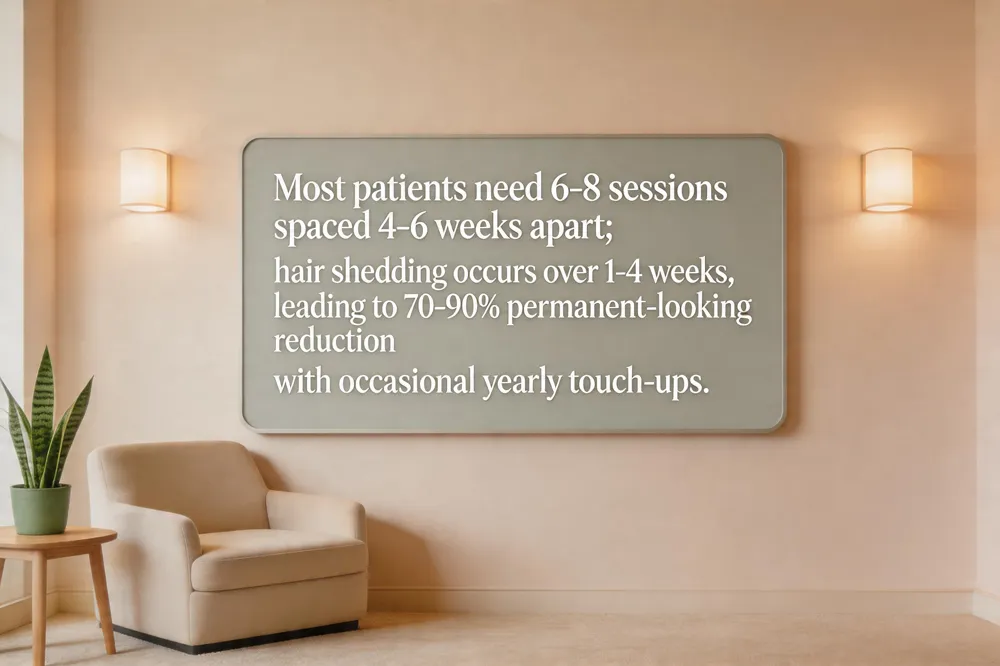 Number of sessions needed – Laser hair removal works best when hair follicles are in their active (anagen) growth phase. Because only a portion of follicles are active at any given time, most patients require 6‑8 sessions spaced 4‑6 weeks apart to achieve long‑term reduction. Some people see noticeable results after 3‑4 sessions, but a full series maximizes the chance of 70‑90 % hair‑free skin.
Hair shedding schedule – Treated hairs do not disappear instantly. After a session the hair enters the telogen (shedding) stage. The first few hairs usually fall out within 1‑3 days, appearing as fine stubble. The bulk of shedding occurs between 1‑2 weeks, and by 3‑4 weeks the treated area looks noticeably smoother. Timing can vary with hair color, thickness, skin type, and the laser wavelength used.
Long‑term results and maintenance – The FDA classifies laser hair removal as “permanent hair reduction.” After a complete series most follicles are permanently damaged, and any regrowth is finer and lighter. Hormonal changes or new follicles may require occasional touch‑ups—typically once a year—to keep results optimal. Results are most durable for dark hair on lighter skin, though modern dual‑wavelength lasers (e.g., Alexandrite / Nd:YAG) expand effectiveness to a broader range of tones.
Patient expectations – Expect a mild, warm‑pinprick sensation during treatment, with temporary redness and swelling that resolves within a few hours to days. The procedure is minimally invasive, requires no downtime, and eliminates razor burn, ingrown hairs, and the repetitive cost of shaving or waxing. Proper after‑care—cool compresses, fragrance‑free moisturizers, and diligent sunscreen use—enhances comfort and supports the smooth, lasting skin results patients seek.
Laser hair removal aftercare exercise – Allow at least 2 hours before light activity and 24‑48 hours before vigorous workouts. Avoid saunas, hot tubs, and excessive sweating during this window. Choose loose, breathable clothing, apply a soothing aloe gel, stay hydrated, and protect the treated skin with SPF 30+ for at least two weeks.
Conclusion
Laser hair removal offers a reliable, long‑lasting solution for smooth, silky skin by targeting melanin in the hair follicle, dramatically reducing hair density, ingrown hairs, and skin irritation. Multiple safe, short sessions—typically six to eight—provide up to 90% permanent reduction, leaving any regrowth finer and lighter, while modern dual‑wavelength lasers accommodate a wide range of skin tones. The procedure is minimally invasive, performed by licensed professionals, and comes with only mild, temporary side effects such as redness or swelling. By eliminating the daily hassle and recurring cost of shaving or waxing, laser hair removal not only saves time and money but also enhances overall skin texture and confidence.
Ready to experience smoother, healthier skin? Schedule a personalized consultation at Jana HealthCare in Brooklyn, NY, where our board‑certified dermatology team tailors each laser plan to your unique skin type and aesthetic goals. Call us today or book online to begin your journey toward lasting hair‑free comfort.